
 Greece
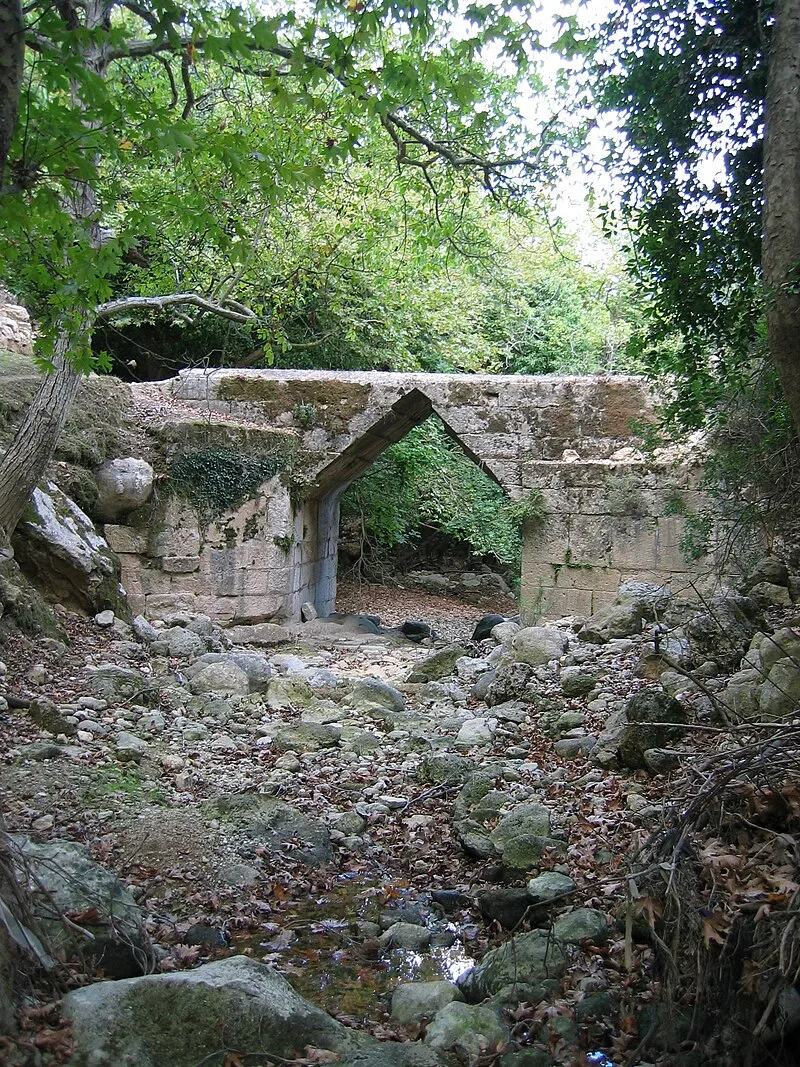
The Eleutherna Bridge is an ancient Greek corbel arch bridge near the Cretan town of Eleutherna, Greece [1]. The well-preserved structure has a single span of 3.95 m, which is quite large for a false arch [1]. The opening is cut from the unmortared limestone blocks in the shape of an isosceles triangle, the height of which is 1.84 m [1]. The overall length of the bridge measures 9.35 m [1]. Its width varies from 5.1 to 5.2 m [1]. The height is between 4 and 4.2 m [1]. The bridge, which is still in use, was first described by the Englishman T.A.B. Spratt in his Travels and Researches in Crete, after he had paid a visit to the site in 1853 [1]. According to Nakassis, the extant, northern bridge was built sometime during the Hellenistic period, while the Italian scholar Galliazzo dates the construction more precisely to the end of the 4th or beginning of the 3rd century BC [1].
Text: Wikipedia – 'Eleutherna Bridge' (revision of 2025-06-16), CC BY-SA 4.0 · sentences selected and shortened by an AI system · source →Eleutherna Bridge
Also known as: Brücke von Eleutherna, Elefthernabrug, Eleuternský most, Eleutherna Köprüsü, Ponte de Eleuterna, Ponte de Eleutherna, Puente de Eleuterna, Γέφυρα της Ελεύθερνας, Елевтернски мост, エレウテルナ橋
| Type | Gate/archway/bridge |
|---|---|
| Period | 500 BC - 1 AD |
| Country | Greece |
| Coordinates | 35.3383° N, 24.6708° E |