
 France
The Temple of Mercury at Puy de Dôme is a Gallo-Roman trachyte temple built in the 2nd century at the summit of the lava dome [1]. It replaced a 1st-century arkose temple on the same site, which was apparently too small to accommodate the many pilgrims who visited [1]. Its remains were revealed by excavation campaigns in 1875 and at the turn of the century [1]. The site was discovered in 1872 during the construction of a meteorological observatory [1]. The 1st-century temple was destroyed around 150 CE and part of its materials used to build the second temple at an altitude around 1,435 meters [1]. The temple was built with local trachyte, assembled in large blocks for the visible parts, with filling made up of smaller trachyte blocks [1]. In all, the building filled an area of around 3,600 m2 [1].
Text: Wikipedia – 'Temple of Mercury (Puy de Dôme)' (revision of 2026-07-21), CC BY-SA 4.0 · sentences selected and shortened by an AI system · source →Temple of Mercury, Puy de Dôme
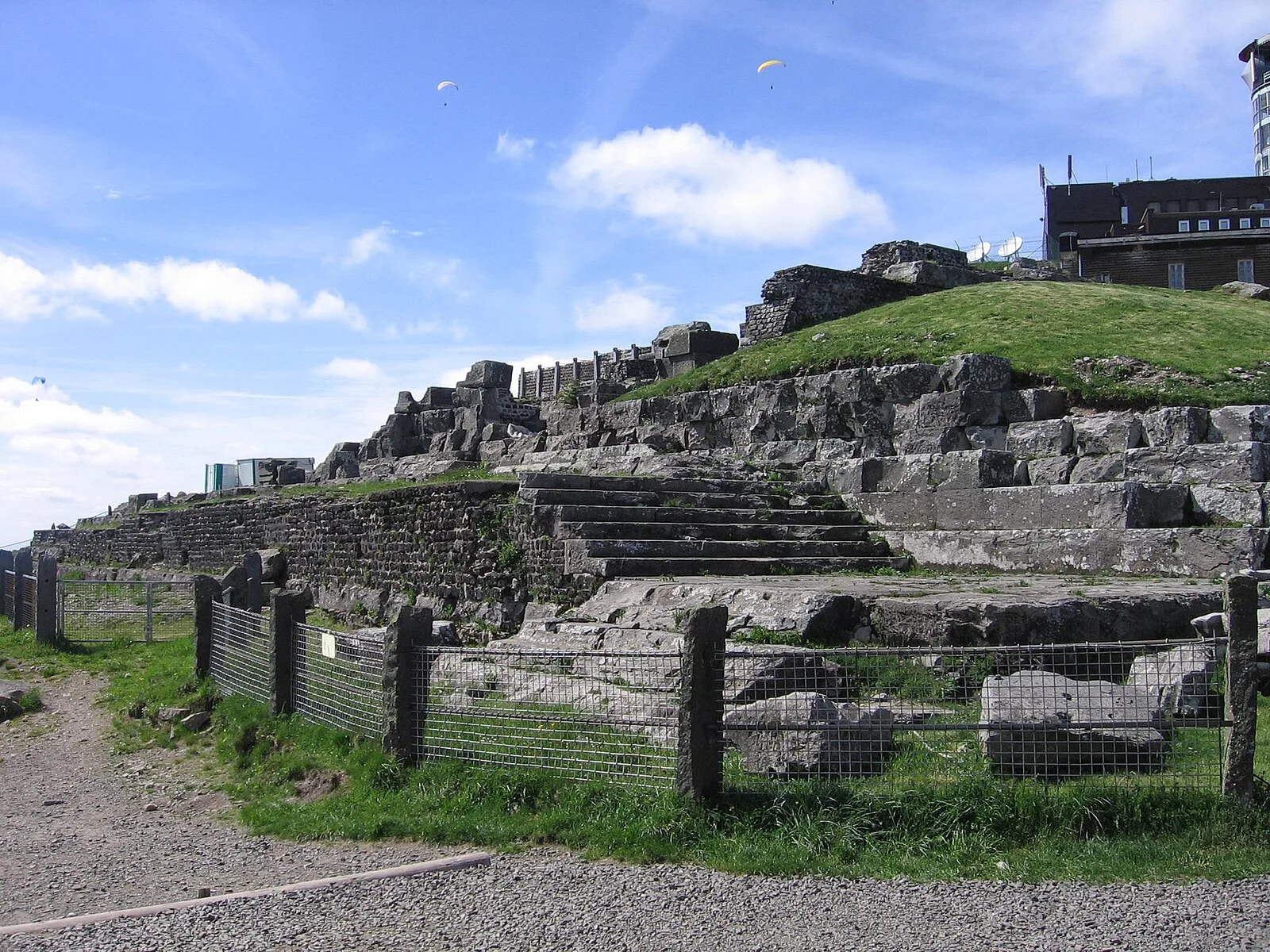
Also known as: temple de Mercure, temple de Mercure (Puy de Dôme), Temple of Mercury (Puy de Dôme), Templo de Mercúrio (Puy de Dôme), معبد ميركورى, 墨丘利神庙
| Type | Temple |
|---|---|
| Period | 1 - 500 AD |
| Country | France |
| Coordinates | 45.7718° N, 2.9644° E |