
 England
The Thornborough Henges are an ancient monument complex that includes the three aligned henges that give the site its name [1]. They are located on a raised plateau above the River Ure near the village of Thornborough in North Yorkshire, England [1]. The site includes many large ancient structures including a cursus, henges, burial grounds and settlements [1]. They are thought to have been part of a Neolithic and Bronze Age 'ritual landscape' comparable to Salisbury Plain and date from between 3500 and 2500 BC [1]. The cursus is the oldest and largest ancient monument at Thornborough [1]. It is almost a mile in extent and runs from Thornborough village, under the central henge and terminates close to the River Ure in a broadly east/west alignment, 8 kilometres north-west of Ripon [1]. The three henges are almost identical in size and composition, each having a diameter of approximately 240 metres and two large entrances situated directly opposite each other [1].
Text: Wikipedia – 'Thornborough Henges' (revision of 2026-06-13), CC BY-SA 4.0 · sentences selected and shortened by an AI system · source →Thornborough Henges
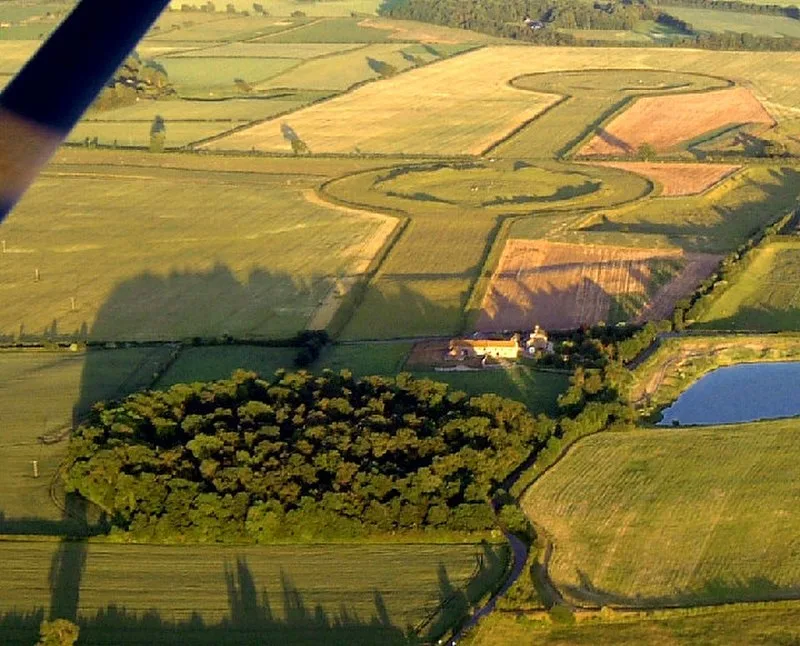
Also known as: Earth circles, cursus, pit alignments and burial sites near Nosterfield and Thornborough, including Centre Hill round barrow, Торнборо-Хенджиз
| Type | Henge |
|---|---|
| Period | 4500 - 3000 BC |
| Country | England |
| Coordinates | 54.2101° N, 1.5638° W |