
 England
Duggleby Howe is one of the largest round barrows in Britain, located on the southern side of the Great Wold Valley in the county of North Yorkshire, and is one of four such monuments in this area, known collectively as the Great barrows of East Yorkshire [1]. Duggleby Howe is believed on the basis of artefacts recovered to be of Late Neolithic date, but no radiocarbon dates are available [1]. The monument consists of a mound, the base of which was 120 feet in diameter [1]. The mound was 22 feet high at the eastern end and 18 or 19 feet high at the western end [1]. The barrow lies within a roughly circular enclosure, approximately 370 metres in diameter, formed from interrupted ditches, and open to the south [1]. The barrow was first excavated in either 1798 or 1799 by the Reverend Christopher Sykes, but no records of his excavation remain [1]. Beginning on 21 July 1890 J. R. Mortimer, under the sponsorship of Sir Tatton Sykes, excavated "an area of 40 feet square over the centre of the barrow, and a portion of the east side" over a period of more than six weeks [1].
Text: Wikipedia – 'Duggleby Howe' (revision of 2025-06-23), CC BY-SA 4.0 · sentences selected and shortened by an AI system · source →Duggleby Howe
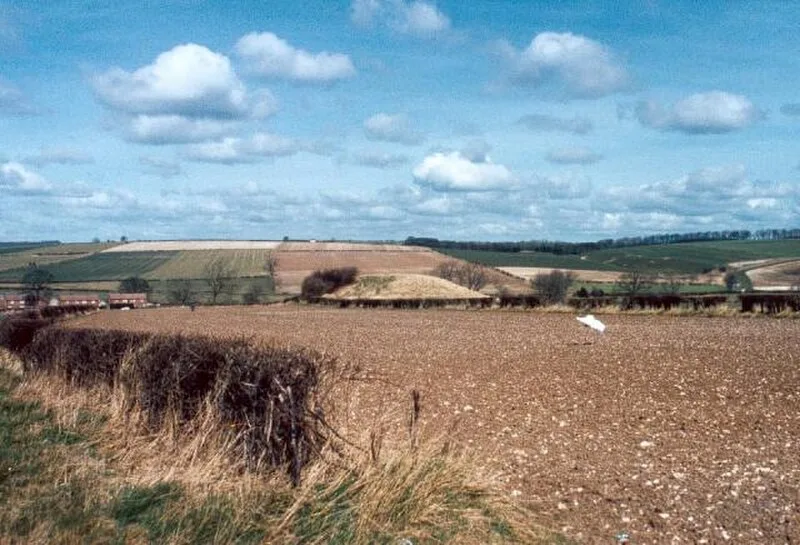
Also known as: Dugglebyhögen
| Type | Barrow |
|---|---|
| Period | 4500 - 3000 BC |
| Country | England |
| Coordinates | 54.0905° N, 0.6555° W |