
 Egypt
EgyptThe Valley of the Queens is a site in Egypt, in which queens, princes, princesses, and other high-ranking officials were buried from roughly 1560 BC to 1130 BC [1]. The Valley of the Queens was known anciently as Ta-Set-Neferu, which has a double meaning of "The Place of Beauty" and/or "the Place of the Royal Children" [1]. Excavation of the tombs at the Valley of the Queens was pioneered by Ernesto Schiaparelli and Francesco Ballerini in the early 1900s [1]. The Valley of the Queens consists of the main wadi, which contains most of the tombs, along with the Valley of Prince Ahmose, the Valley of the Rope, the Valley of the Three Pits, and the Valley of the Dolmen [1]. The main wadi contains 91 tombs and the subsidiary valleys add another 19 tombs [1]. The burials in the subsidiary valleys all date to the 18th Dynasty [1]. The Valley was no longer a royal burial site after the close of the 20th Dynasty [1]. Not much is known about the use of the Valley of the Queens during the Ptolemaic Period but during the Roman Period there was a renewed, extensive use of the Valley as a burial site [1].
Text: Wikipedia – 'Valley of the Queens' (revision of 2026-07-19), CC BY-SA 4.0 · sentences selected and shortened by an AI system · source →Valley of the Queens
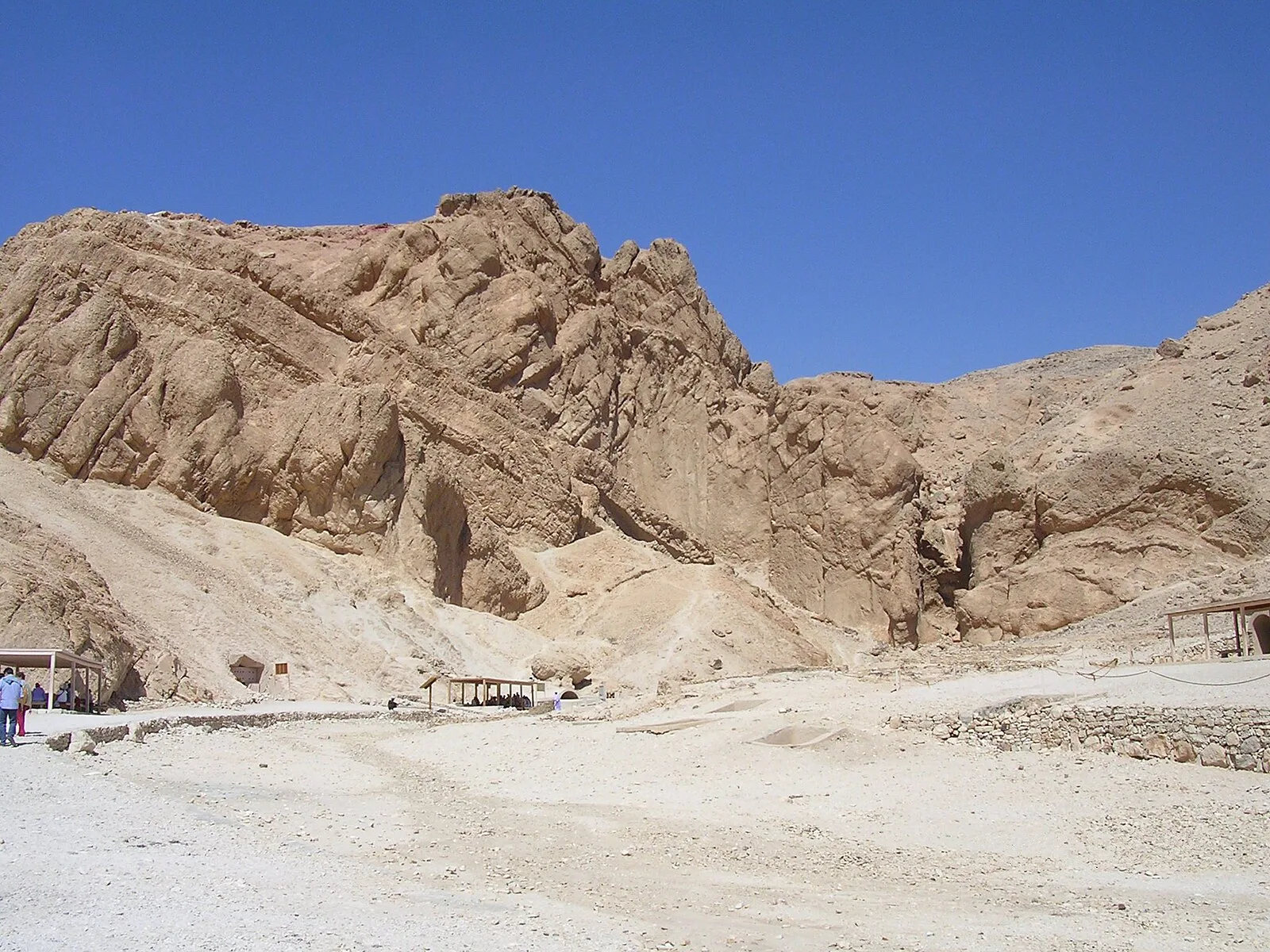
Also known as: 왕비의 계곡, Dolina kraljic, Dolina kraljica, Dolina Królowych, Dronningernes dal, Drottningarnas dal, Erreginen Harana, Karalienių slėnis, Királynék völgye, Kraliçeler Vadisi, Kuningattarien laakso, Lembah Para Ratu
| Type | Necropolis/tombs complex |
|---|---|
| Period | 3000 - 1500 BC |
| Country | Egypt |
| Coordinates | 25.7277° N, 32.5930° E |