
 Egypt
EgyptDeir el-Shelwit is an Egyptian temple built during the Greco-Roman period [1]. Dedicated to Isis, a major goddess in the Egyptian religion, the temple stands on the west bank of the Nile at the city of Luxor, roughly 1 km from Malkata and about 4 km south of Medinet Habu [1]. The reliefs of the temple are similar to the ones at Dendera and Philae [1]. On the walls of the temple and the pylon, there are cartouches of the Roman emperors Hadrian, Antoninus Pius, Galba, Otho, Vespasian, and of the Roman dictator Julius Caesar [1]. Today all that remains of the temple is its small main building and ruins of the propylon, along with its brick enclosure wall and the well [1]. The temple precinct had an area of 78×58 metres; the temple itself is much smaller, with an area of 13×16 m [1]. The temple was first examined by Karl Richard Lepsius in the mid-19th century, but he did not make a detailed description of it [1]. Remains found in the well prove that the well (and the temple itself) was already abandoned and used as a trash deposit by the Coptic era [1].
Text: Wikipedia – 'Deir el-Shelwit' (revision of 2026-08-11), CC BY-SA 4.0 · sentences selected and shortened by an AI system · source →Deir el-Shelwit Temple
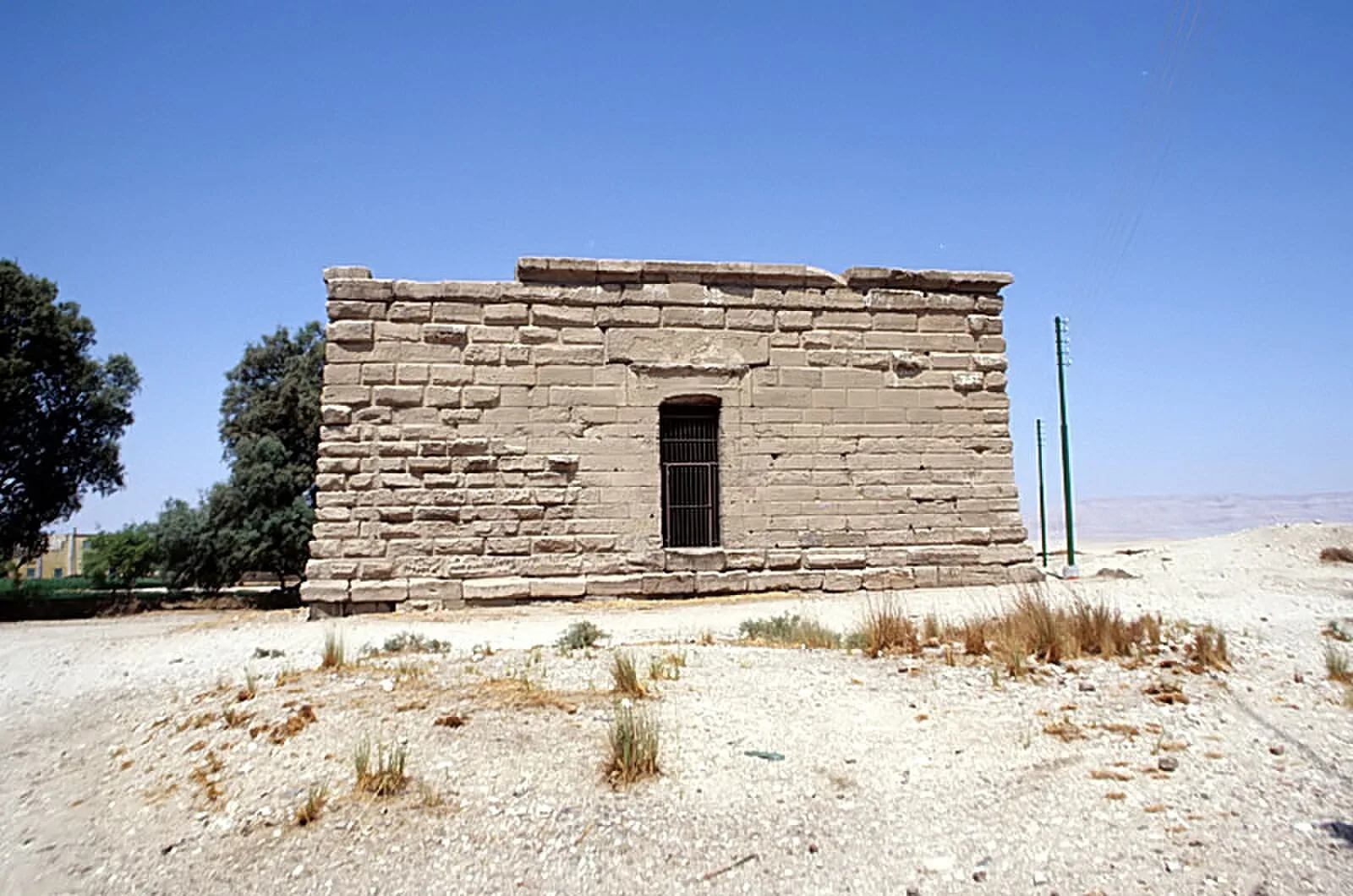
Also known as: Dair Schelwit, Deir el-Schelwit, Deir el-Shelwit, Dejr es-Selvít, Temple d'Isis de Deir Chelouit, temple romà de Deir Shelwit, دير الشلويط, معبد دیر شلویط
| Type | Temple complex |
|---|---|
| Period | 1 - 500 AD |
| Country | Egypt |
| Coordinates | 25.6960° N, 32.5787° E |