
 Egypt
EgyptThe Ramesseum is the memorial temple of Pharaoh Ramesses II ("Ramesses the Great") [1]. It is located in the Theban Necropolis in Upper Egypt, on the west of the River Nile, across from the modern city of Luxor [1]. It is the second largest temple in Egypt, occupying an area of c. 10 hectares (1,100,000 sq ft) [1]. Oriented northwest and southeast, the temple itself comprised two stone pylons (gateways, some 60 metres (200 ft) wide), one after the other, each leading into a courtyard [1]. Beyond the second courtyard, at the centre of the complex, was a covered 48-column hypostyle hall, surrounding the inner sanctuary [1]. The site is notable for its true arches made of mud bricks that were not wedge-shaped as proper voussoirs, but simply held in place by mortar and thus prone to collapse, leaving very few examples still standing [1]. Ramesseum has the oldest such arch still standing in Egypt (c. 1300 BC) [1].
Text: Wikipedia – 'Ramesseum' (revision of 2026-09-09), CC BY-SA 4.0 · sentences selected and shortened by an AI system · source →The Ramesseum
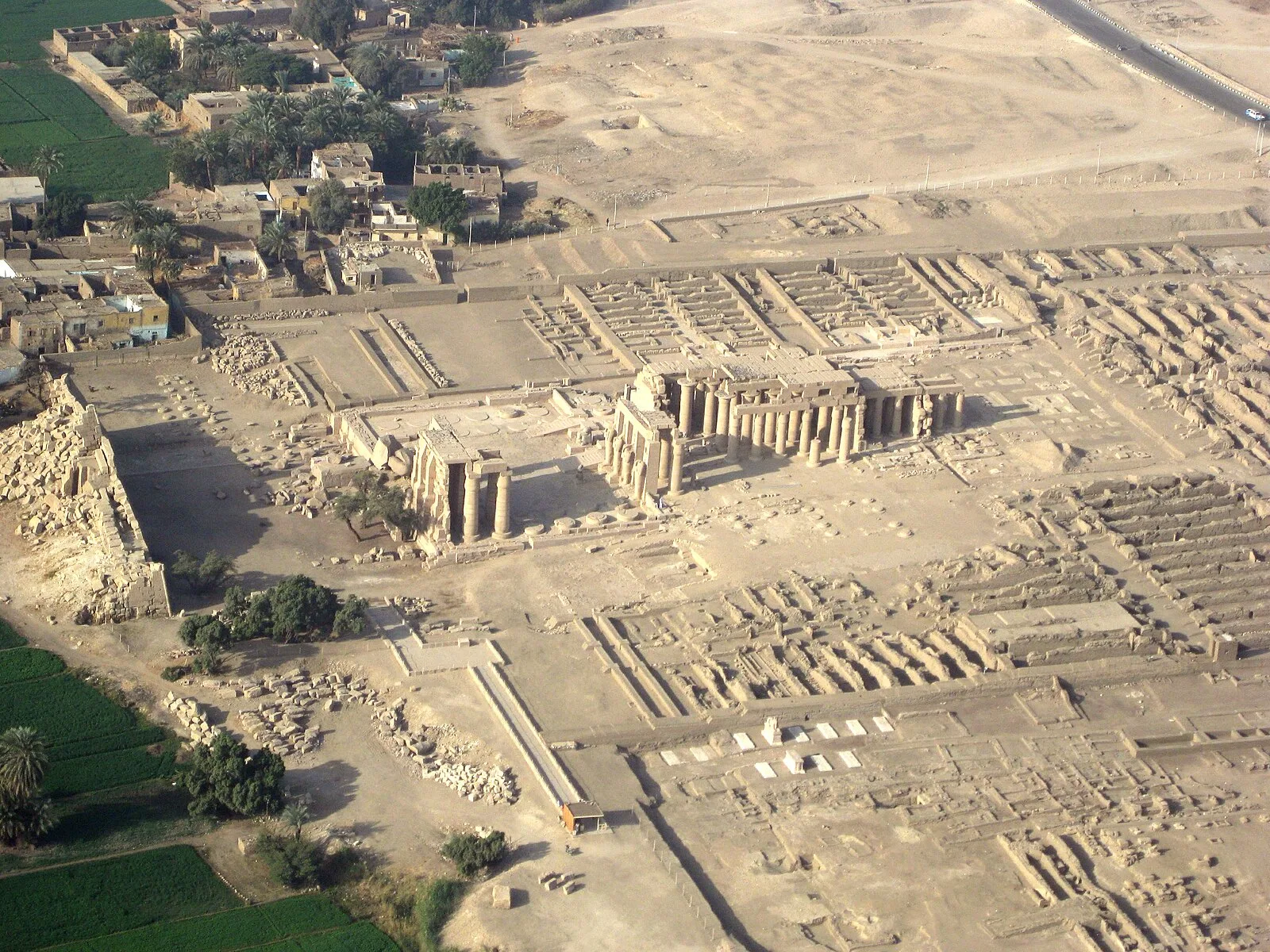
Also known as: Rameseo, Rameseum, Ramesseo, Ramesseum, Ramesszeum, Ramezėjus, Ramzesseum, Temple de Ramsès II, Temple des millions d'années de Ramsès II, Temple mortuori de Ramsès II, Ραμέσσειο, Ραμσείο
| Type | Temple complex |
|---|---|
| Period | 1500 - 500 BC |
| Country | Egypt |
| Coordinates | 25.7278° N, 32.6106° E |