
 Egypt
EgyptThe Mortuary Temple of Amenhotep III, also known as Kom el-Hettân, was built by the main architect Amenhotep, son of Hapu, for Pharaoh Amenhotep III during the 18th dynasty of the New Kingdom [1]. The mortuary temple is located on the Western bank of the Nile river, across from the eastern bank city of Luxor [1]. During its time, the Mortuary Temple of Amenhotep III was the largest funerary complex in Thebes that was built [1]. Only parts of the mortuary temple's layout remain, as well as the Colossi of Memnon, which are two large stone statues of Amenhotep III and his family guarding the entrance measuring 18 meters high [1]. New research indicates that a large majority of the destruction on the mortuary temple can be attributed to the effects of an earthquake [1]. It was long speculated that the earthquake occurred around 27 BC; however, investigations into the mortuary temple and surrounding colossi have debunked this time frame and instead have demonstrated it occurred around 1200 BC [1].
Text: Wikipedia – 'Mortuary Temple of Amenhotep III' (revision of 2026-07-18), CC BY-SA 4.0 · sentences selected and shortened by an AI system · source →Mortuary Temple of Amenhotep III
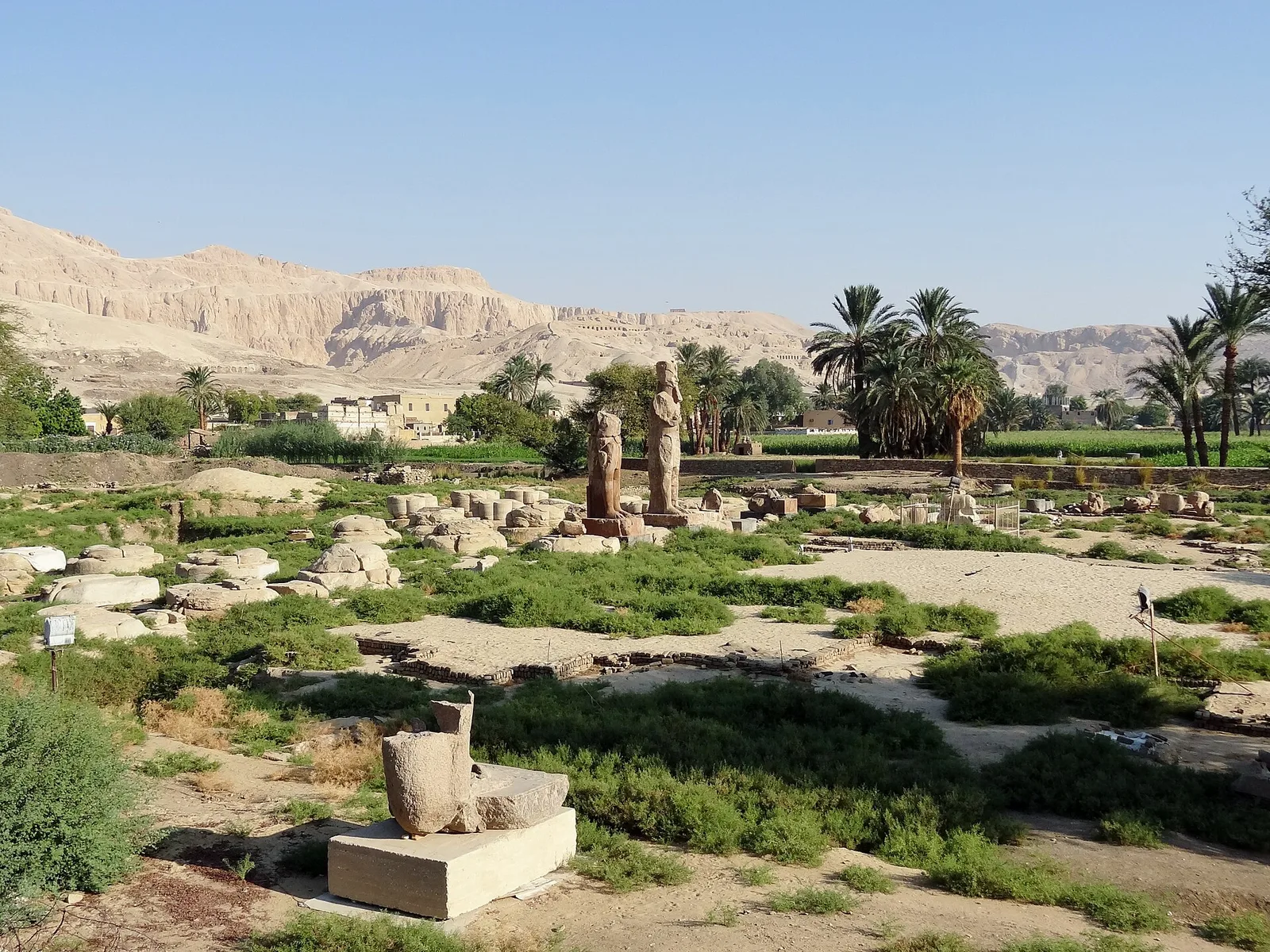
Also known as: Dodentempel van Amenhotep III, Dodetempel van Amenhotep III, Gidan gawawwaki na Amenhotep III, III. Amenhotep halotti temploma, Kom el-Hettan, Tempel des Amenophis III., tempio funerario di Amenhotep III, tempio funerario di Amenofi III, Temple d’Amenhotep III, Temple d'Amenofis III, Temple des millions d'annees d'Amenhotep III, Templo funerario de Amenhotep III
| Type | Temple complex |
|---|---|
| Period | 1500 - 500 BC |
| Country | Egypt |
| Coordinates | 25.7217° N, 32.6090° E |