
 Egypt
EgyptThe Colossi of Memnon are two large stone statues of the Pharaoh Amenhotep III, which stand at the front of the ruined Mortuary Temple of Amenhotep III [1]. They have stood since 1350 BC, and were well known to ancient Greeks and Romans [1]. The statues contain 107 Roman-era inscriptions in Greek and Latin, dated to between AD 20 and 250; many of these inscriptions on the northernmost statue make reference to the Greek mythological king Memnon, whom the statue was then erroneously thought to represent [1]. Soon after its construction the temple was destroyed by an earthquake, recently dated by the Armenian Institute of Seismology to around 1200 BC, which left only the two huge colossi at the entrance still standing [1]. These were further destroyed by an earthquake in 27 BC, after which they were partly reconstructed by the Roman authorities [1].
Text: Wikipedia – 'Colossi of Memnon' (revision of 2026-07-05), CC BY-SA 4.0 · sentences selected and shortened by an AI system · source →Colossi of Memnon
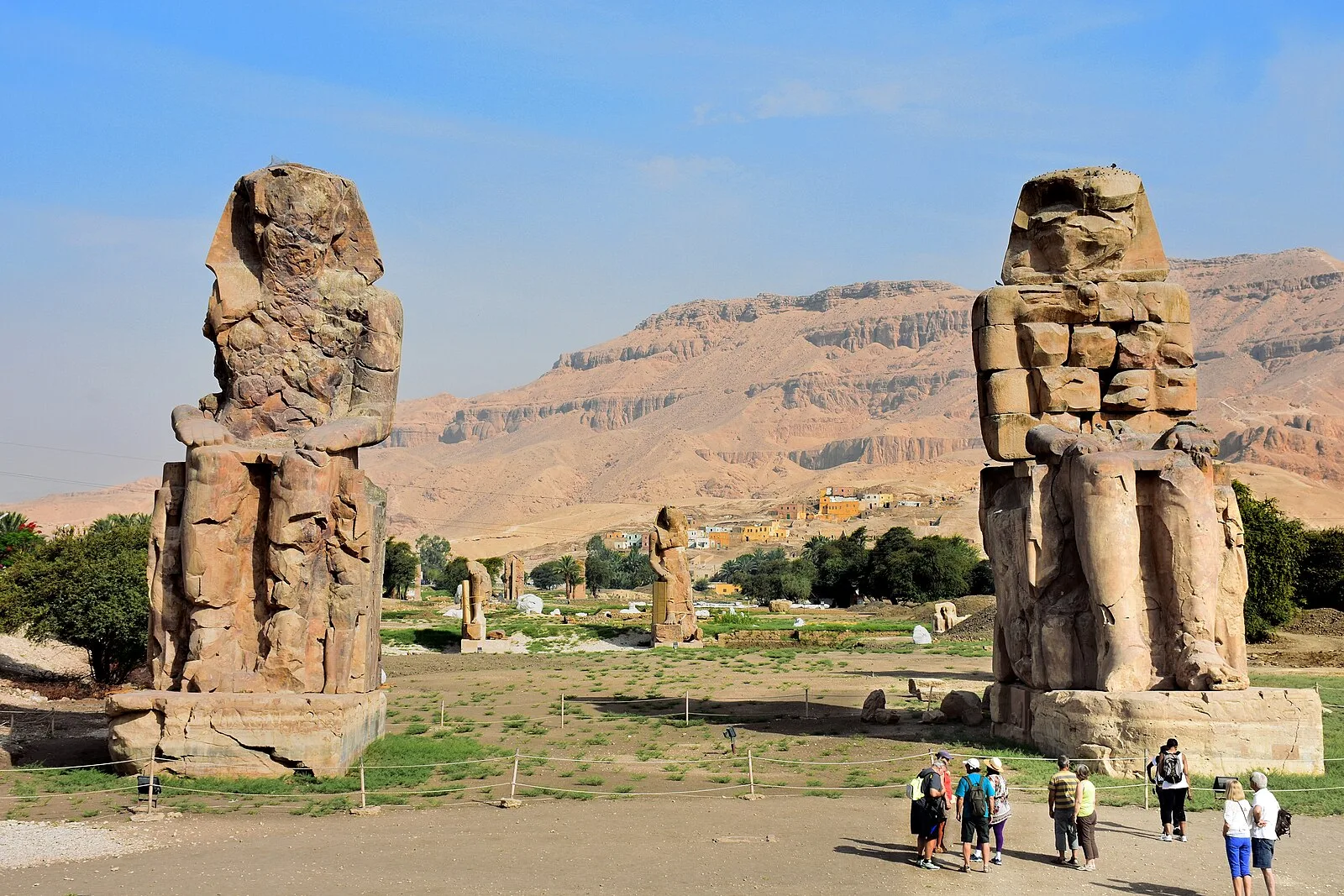
Also known as: 멤논의 거상, Al Colossat, Al-Colossat, Coloșii lui Memnon, Colosos de Memnon, Colossen van Memnon, Colosses de Memnon, Colossi di Memnon, Colossi di Memnone, Colossi di Mennone, Colossi Memnonis, Colossi of Memnon at Theban necropolis
| Type | Megalithic statues |
|---|---|
| Period | 1500 - 500 BC |
| Country | Egypt |
| Coordinates | 25.7207° N, 32.6105° E |