
 Pakistan
The Great Bath is one of the best-known structures among the ruins of the Harappan Civilization, excavated at Mohenjo-daro in present-day Sindh province of Pakistan [1]. Archaeological evidence indicates that the Great Bath was built in the third millennium BCE, soon after the raising of the "citadel" mound on which it is located [1]. The Great Bath of Mohenjo-Daro is called the "earliest public water tank of the ancient world" [1]. It measures approximately 12 metres by 7 metres, with a maximum depth of 2.4 metres [1]. Two wide staircases, one from the north and one from the south, served as the entry to the structure [1]. A ledge 1.4 metres high extending the entire width of the bath is at the lower ends of these stairs [1]. The floor of the tank was watertight due to finely fitted bricks laid on edge with a gypsum plaster, and the side walls were constructed in a similar manner [1].
Text: Wikipedia – 'Great Bath' (revision of 2026-09-10), CC BY-SA 4.0 · sentences selected and shortened by an AI system · source →Great Bath
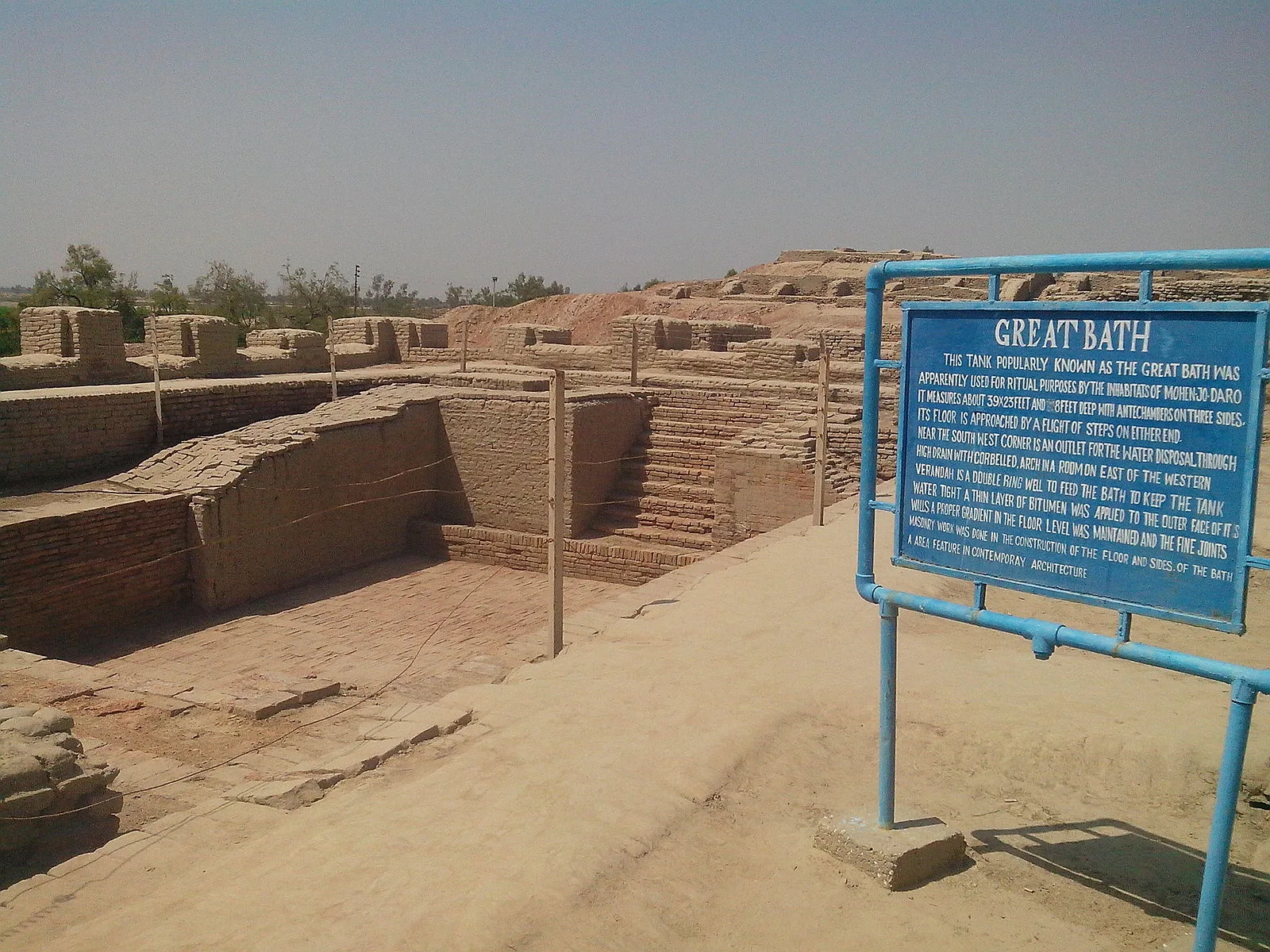
Also known as: 대욕장, 대욕탕, Banja e Madhe, Banja e Madhe e Mohenjo-daro-s, Banja e Madhe e Mohenxho-daros, Banja e Madhe, Mohenjo-daro, Banja e Madhe në Mohenjo-daro, Büyük Hamam (Mohenjo-daro), Grand bain de Mohenjo-daro, Grande Bagno, Grandes baños de Mohenjo-Daro, Grands bains de Mohenjo-daro
| Type | Bath |
|---|---|
| Period | 3000 - 1500 BC |
| Country | Pakistan |
| Coordinates | 27.3255° N, 68.1329° E |