
 Italy
ItalyThe Tomb of the Diver is a frescoed tomb that dates to around 500 to 475 BCE, and is famous for the mysterious subject matter of the ceiling fresco [1]. The tomb was built with five large stone slabs, each with a fresco attributed to one of two artists [1]. The four walls are decorated with scenes of a symposium which is uncommon for a funerary context [1]. The Tomb of the Diver is an archaeological monument, built in about 500 to 475 BCE and found by the Italian archaeologist Mario Napoli on 3 June 1968 during his excavation of a small necropolis about 1.5 km south of the Greek city of Paestum in Magna Graecia [1]. The five slabs, carefully bonded with plaster, formed a chamber about 215 × 100 × 80 cm in size [1]. The paintings on the four walls depict a symposium scene, while the cover slab shows the famous scene which gives the tomb its name: a young man diving into a curling and waving stream of water [1].
Text: Wikipedia – 'Tomb of the Diver' (revision of 2026-09-11), CC BY-SA 4.0 · sentences selected and shortened by an AI system · source →Tomb of The Diver, Paestum
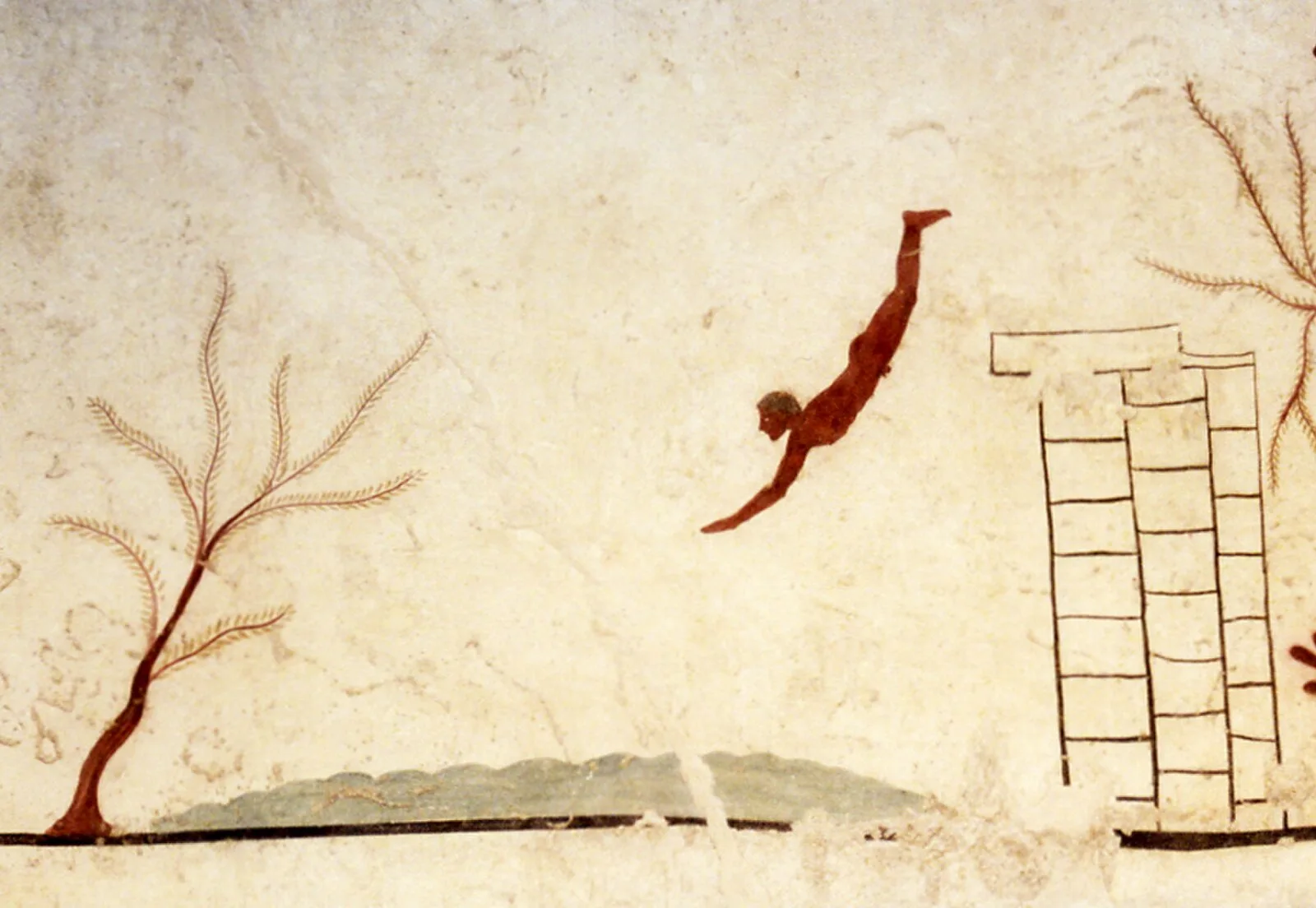
Also known as: A búvár sírja, Dykarens grav, Dykkerens grav, Fresque de la Tombe du Plongeur, Fresques de la Tombe du Plongeur, Grab des Tauchers, Grob skakalca v vodo, Tomba del cabussador, tomba del capbussador, Tomba del Tuffatore, Tomb of the Diver, Tuffatore di Paestum
| Type | Necropolis/tombs complex |
|---|---|
| Period | 500 BC - 1 AD |
| Country | Italy |
| Coordinates | 40.4006° N, 14.9999° E |