
 Italy
ItalyThe Stabian Baths are an ancient Roman bathing complex in Pompeii, Italy [1]. They were the oldest and the largest of the five public baths in the city and centrally located at the intersection of two main streets [1]. Their original construction dates to c. 125 BC, making them one of the oldest bathing complexes known from the ancient world [1]. They were remodelled and enlarged many times up to the eruption of Vesuvius in 79 AD [1]. Excavations in 2021 and 2023 have revised the layout of several phases of the baths and discovered two previously unknown laconica (saunas or sweat baths) under the palaestra courtyard [1]. In ca. 125 BC a magistrate had the first bath building constructed using fines levied by the local administration [1]. The building contained two sets of bath suites each with apodyterium, tepidarium and caldarium, a latrine and, for the men, two laconica and the rectangular palaestra with Doric porticoes on three sides [1].
Text: Wikipedia – 'Stabian Baths' (revision of 2026-06-15), CC BY-SA 4.0 · sentences selected and shortened by an AI system · source →Stabian Baths, Pompeii
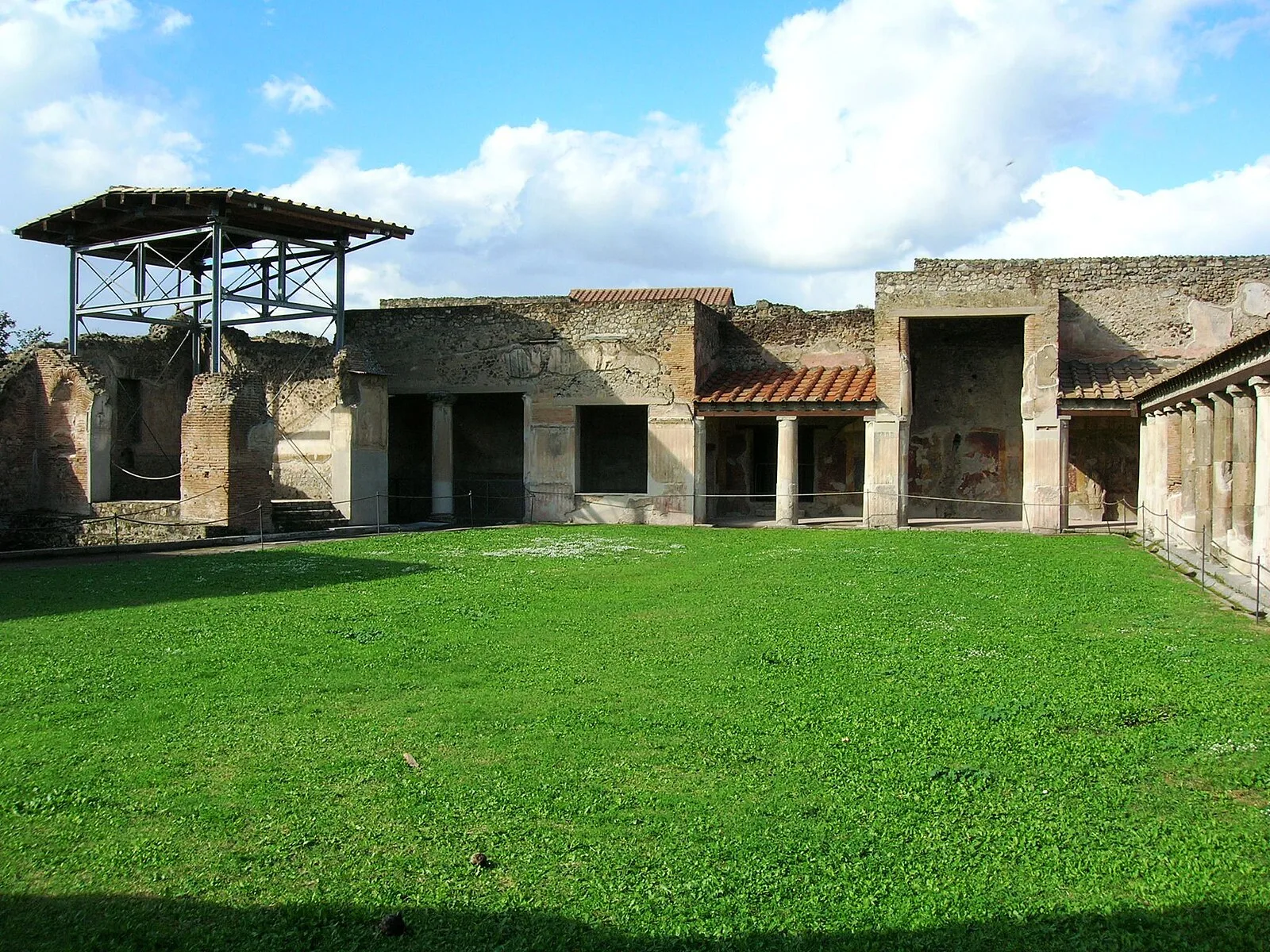
Also known as: Lázně Stabian, Pompeii VII.1.8, Pompei VII.1.8, Stabiaanse thermen, Stabiaen kylpylä, Stabian Baths, Stabianer Thermen, Stabijske terme, Termele Stabiane, termes estabianes, Terme Stabiane, Terme Stabiane (VII.1.8)
| Type | Bath |
|---|---|
| Period | 500 BC - 1 AD |
| Country | Italy |
| Coordinates | 40.7500° N, 14.4877° E |