
 Italy
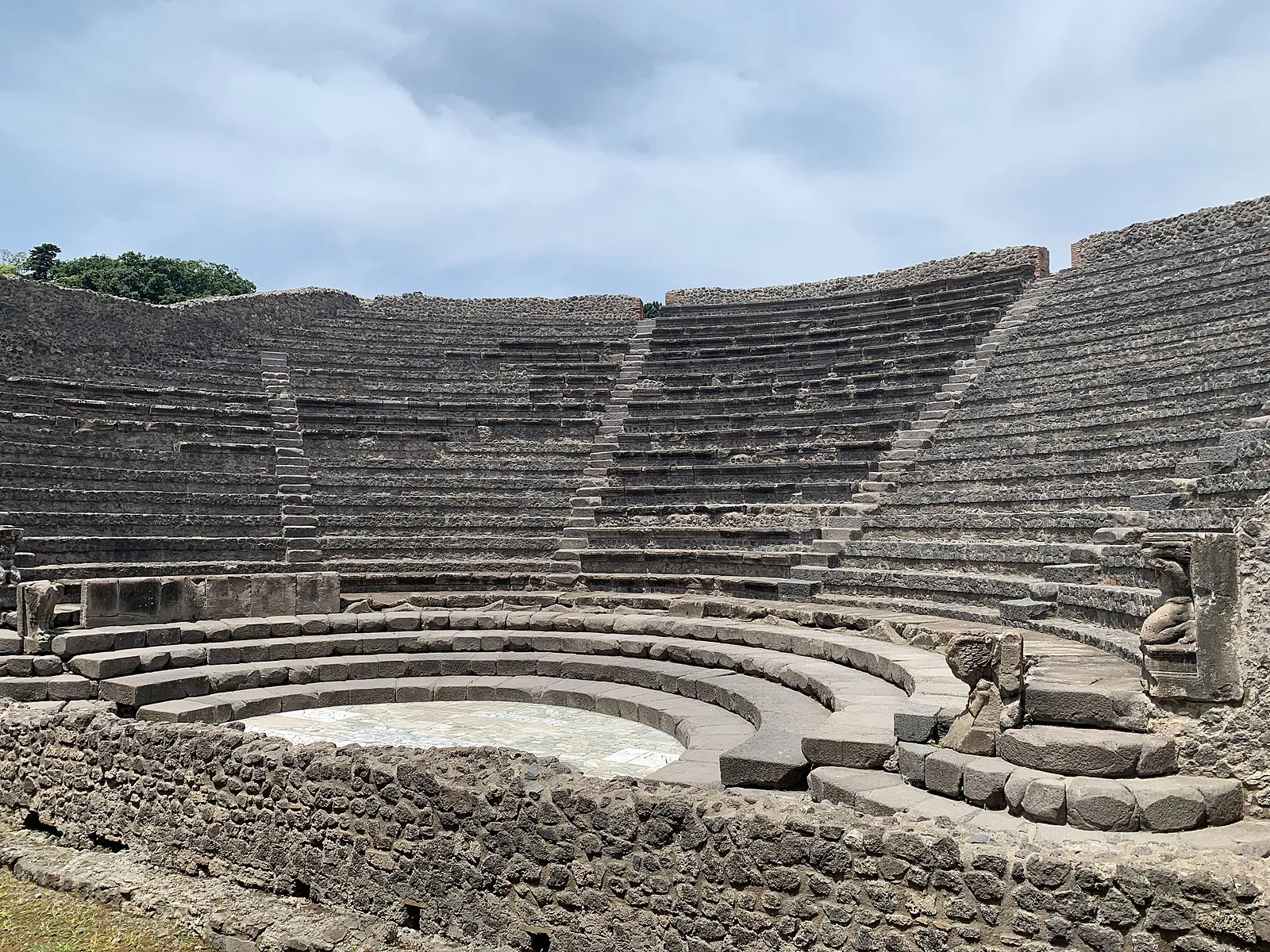
ItalyThe theatre area of Pompeii is located in the southwest region of the city [1]. There are three main buildings that make up this area: the Large Theatre, the Odeon (small theatre), and the Quadriporticum [1]. These served as an entertainment and meeting centre of the city [1]. The Large Theatre was built into a natural hill in the second century BC and was one of the first permanent stone theatres in the Roman empire [1]. It sat roughly 5,000 spectators [1]. Around 2 BC, the theatre was renovated and presented to the city of Pompeii as a gift by two relatives, M. Holconius Rufus and M. Holconius Celer, according to an inscription in the theatre [1]. The Odeon was a smaller roofed theatre, theatrum tectum, that sat 1500 spectators and was built in 80 BC [1].
Text: Wikipedia – 'Theatre Area of Pompeii' (revision of 2026-02-14), CC BY-SA 4.0 · sentences selected and shortened by an AI system · source →Theatre Area of Pompeii
| Type | Theatre |
|---|---|
| Period | 500 BC - 1 AD |
| Country | Italy |
| Coordinates | 40.7501° N, 14.4861° E |