
 Italy
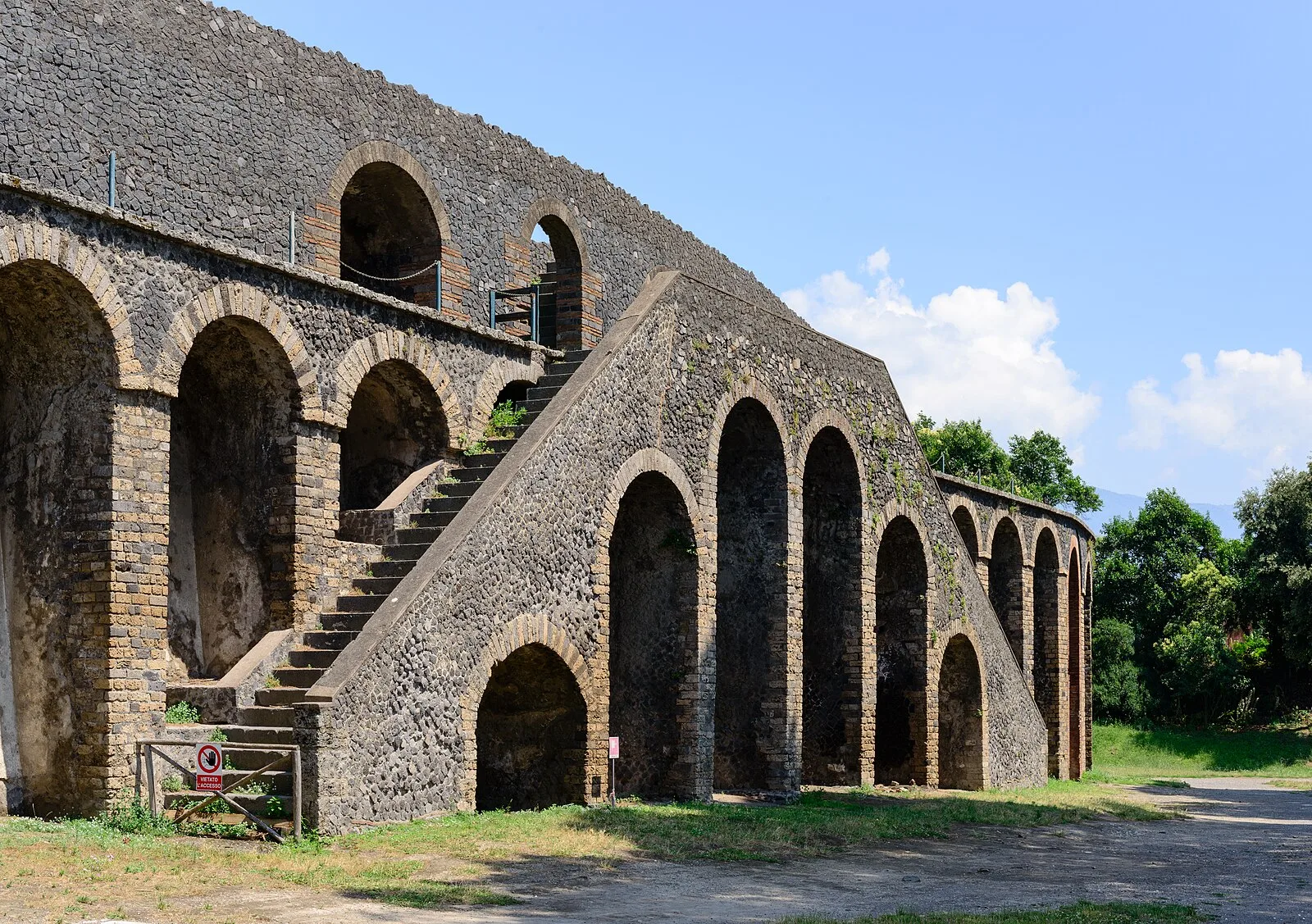
ItalyThe Amphitheatre of Pompeii is one of the oldest surviving Roman amphitheatres [1]. It is located in the ancient city of Pompeii, near Naples, and was buried by the eruption of Mount Vesuvius in 79 AD, along with the city of Pompeii and the neighbouring town of Herculaneum [1]. Built around 70 BC, the amphitheatre is one of the earliest Roman amphitheatres built of stone; previously, they had been built out of wood [1]. The amphitheatre was designed to host around 20,000 people [1]. One of the most notable events in the amphitheatre's history occurred around 59 AD, when a deadly brawl occurred between Pompeiians and residents of Nuceria during games in the amphitheatre, resulting in a 10-year ban on such events there [1]. The amphitheatre was damaged by an earthquake in 62 AD [1]. The amphitheatre was first partially excavated in 1748 [1]. It was later completely excavated between 1813 and 1816 [1].
Text: Wikipedia – 'Amphitheatre of Pompeii' (revision of 2026-08-15), CC BY-SA 4.0 · sentences selected and shortened by an AI system · source →Amphitheatre of Pompeii
Also known as: 폼페이 원형극장, Amfiteatar u Pompejima, Amfiteáter v Pompejach, Amfiteátr v Pompejích, Amfiteatr w Pompejach, Amfitheater van Pompeii, Amphitheater von Pompeji, amphithéâtre de Pompéi, Anfiteatro de Pompeia, Anfiteatro romano de Pompeya, anfiteatro romano di Pompei, Anfiteatro romano di Pompei (II.6.1)
| Type | Amphitheatre |
|---|---|
| Period | 500 BC - 1 AD |
| Country | Italy |
| Coordinates | 40.7514° N, 14.4950° E |