
 Italy
ItalyThe House of Loreius Tiburtinus is renowned for well-preserved art, mainly in wall-paintings as well as its large gardens [1]. It is in the Roman city of Pompeii and with the rest of Pompeii was preserved by the volcanic eruption of Mount Vesuvius in or after October 79 AD [1]. The House of Loreius Tiburtinus was discovered and excavated between the years 1916 and 1921 by Vittorio Spinazzola [1]. The two original structures combined to form this palatial residence were originally built during the Samnite period around the 3rd century BC [1]. The domus covered an entire insula before the earthquake of 62 AD and had two atriums and two entrances [1]. The house is particularly well known for its extensive gardens and outdoor ornamentation, including two perpendicular euripi, water channels named after the strait of Euripus between Euboea and the main Greek peninsula [1]. These channels with fountains were the centerpiece for many frescoes and statuettes [1].
Text: Wikipedia – 'House of Loreius Tiburtinus' (revision of 2026-08-20), CC BY-SA 4.0 · sentences selected and shortened by an AI system · source →House of Loreius Tiburtinus, Pompeii
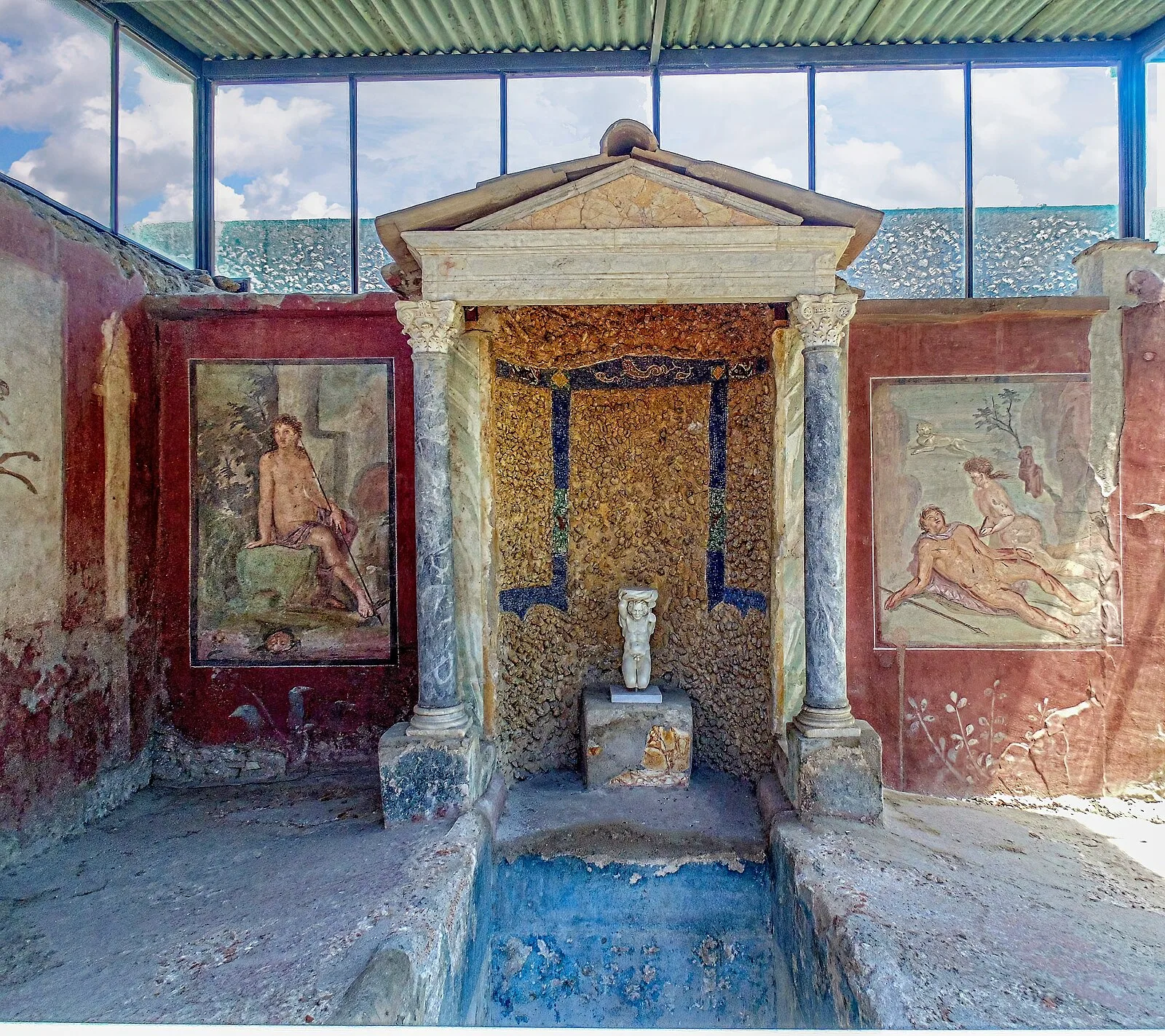
Also known as: Casa de Loreio Tiburtino, Casa de Octavius Quartione, casa di Loreio Tiburtino, Casa di Octavius Quartio, Casa di Octavius Quartione, casa di Ottavio Quartione, Casa di Ottavio Quartione (II.2.2), Dom Lorejusza Tyburtynusa, Haus des D. Octavius Quartio, House of Loreius Tiburtinus, House of Octavius Quartio, Kuća Loreja Tiburtina
| Type | Residence/villa/farmhouse |
|---|---|
| Period | 500 BC - 1 AD |
| Country | Italy |
| Coordinates | 40.7518° N, 14.4925° E |