
 Italy
ItalyThe House of Menander is one of the richest and most magnificent houses in ancient Pompeii in terms of architecture, decoration and contents, and covers a large area of about 1,800 square metres occupying most of its insula [1]. The house was excavated between November 1926 and June 1932 and is located in Region I, Insula 10, Entrance 4 of the city [1]. The oldest part of the house consists of a relatively modest atrium with immediately surrounding rooms built in 250 BC [1]. About 100 years later the domus was modernised; tuff capitals were used for the entrance door and the tablinum [1]. In the Augustan period the domus was substantially modified; a peristyle was built using the space from the demolition of the adjacent residential buildings [1]. In the space to the west, elaborately decorated thermal baths were created, centred around a small 8-columned atrium [1]. In a corridor next to the small atrium of the private baths a treasure trove of 118 silver vases was found which had been carefully wrapped in cloth drapes and placed in a tall wooden cabinet during the renovation of the house [1].
Text: Wikipedia – 'House of Menander' (revision of 2026-07-20), CC BY-SA 4.0 · sentences selected and shortened by an AI system · source →House of Menander, Pompeii
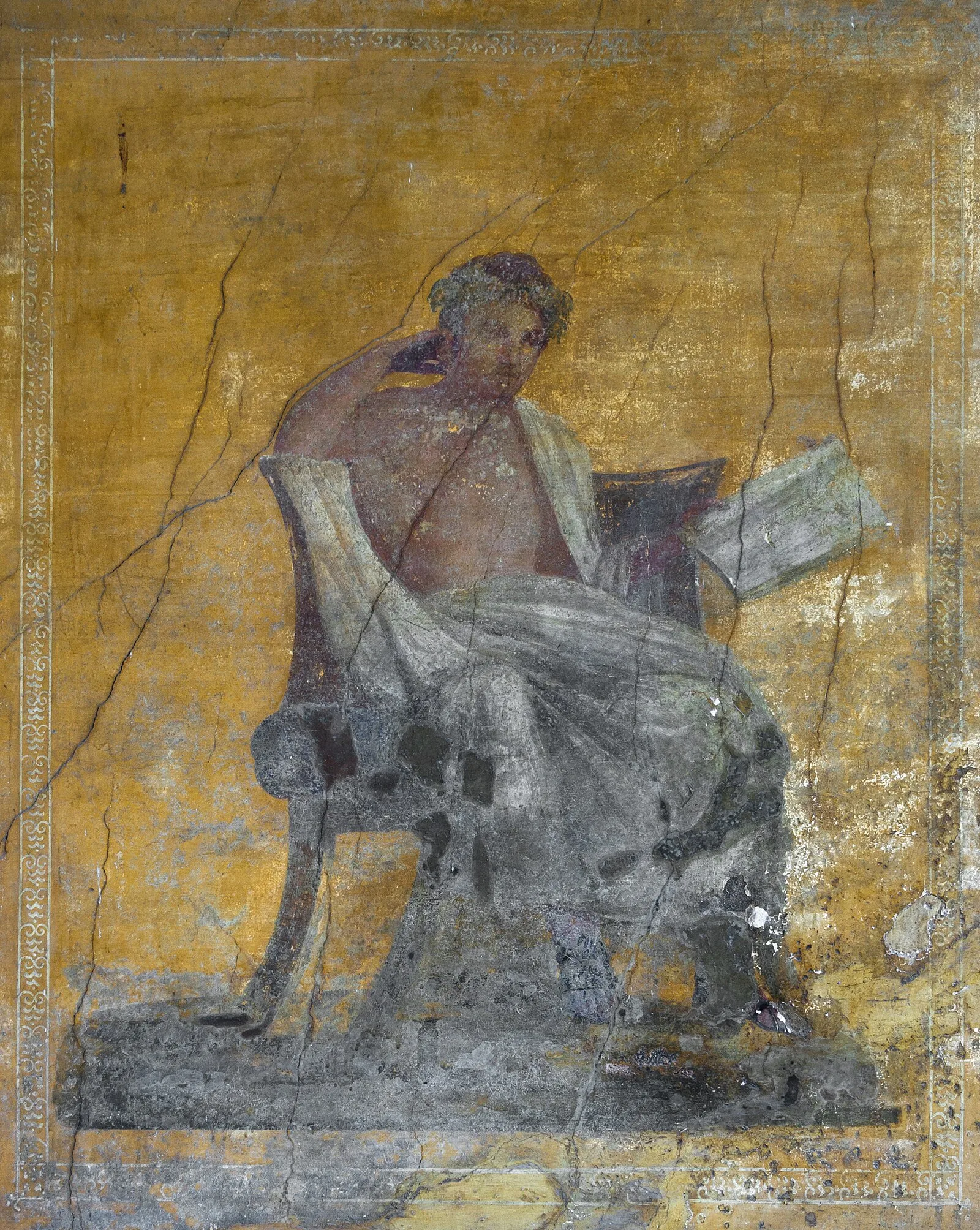
Also known as: Casa del Menandre, Casa del Menandro, Casa del Menandro (I.10.4), Casa de Menandro, Casa di Menandro, Dom Menandra, Haus des Menander, Haus des Menander (Pompeji), House of Menander, House of the Menander, Menandroksen talo, Menandrova kuća
| Type | Residence/villa/farmhouse |
|---|---|
| Period | 500 BC - 1 AD |
| Country | Italy |
| Coordinates | 40.7499° N, 14.4900° E |