
 Italy
ItalyThe House of the Greek Epigrams is a Roman residence in the ancient town of Pompeii that was destroyed by the eruption of Mount Vesuvius in 79 CE [1]. It is named after wall paintings with inscriptions from Greek epigrams in a small room next to the peristyle [1]. The home at the time it was destroyed was the result of merging at least two earlier dwellings dating back to the second half of the second century B.C.E. It is estimated this merger occurred around the third quarter of the first century B.C.E. It is thought further alterations took place in the second half of the first century CE as well [1]. The first of the home's rooms were discovered in April 1748 during the very first days of the excavation of Pompeii [1]. More of its rooms were unearthed in late 1875 - 1876 and additional excavations were conducted in 1908 [1]. On November 16 of 1875, a necklace of gold with emeralds and pearls and parts of a silver service as well as an ivory statuette depicting Venus were recovered in the atrium [1].
Text: Wikipedia – 'House of the Greek Epigrams' (revision of 2026-07-17), CC BY-SA 4.0 · sentences selected and shortened by an AI system · source →House of the Greek Epigrams, Pompeii
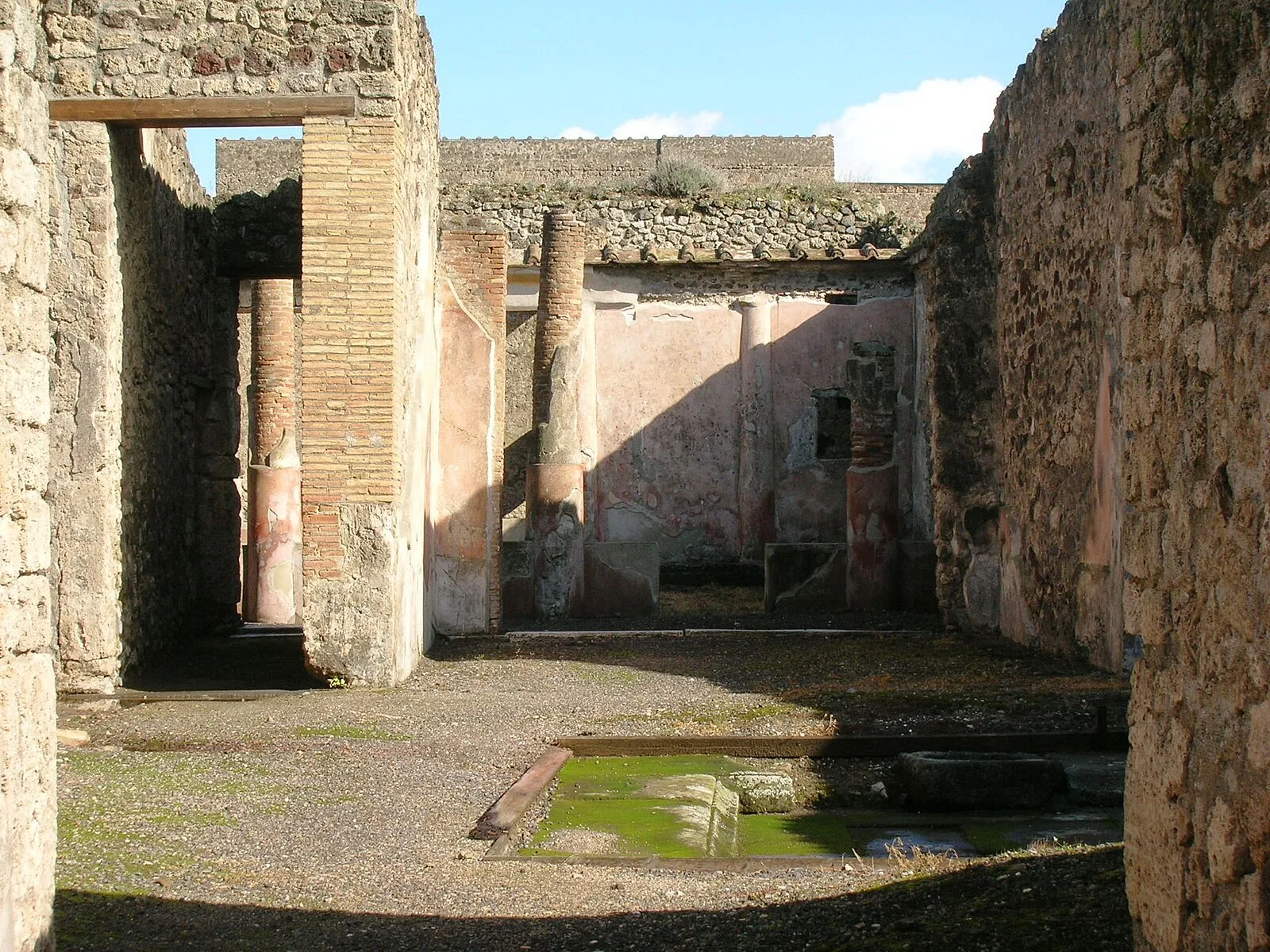
Also known as: Casa degli Epigrammi, Casa degli Epigrammi Greci, casa degli Epigrammi Greci (V.1.18), Casa de los epigramas griegos, Haus der Epigramme, House of the Epigrams, House of the Greek Epigrams, Huis van de Griekse epigrammen, Kuća grčkih epigrama, Pompeii V.1.18, Pompei V.1.18, בית האפיגרמות היווניות
| Type | Residence/villa/farmhouse |
|---|---|
| Period | 500 BC - 1 AD |
| Country | Italy |
| Coordinates | 40.7524° N, 14.4859° E |