
 Italy
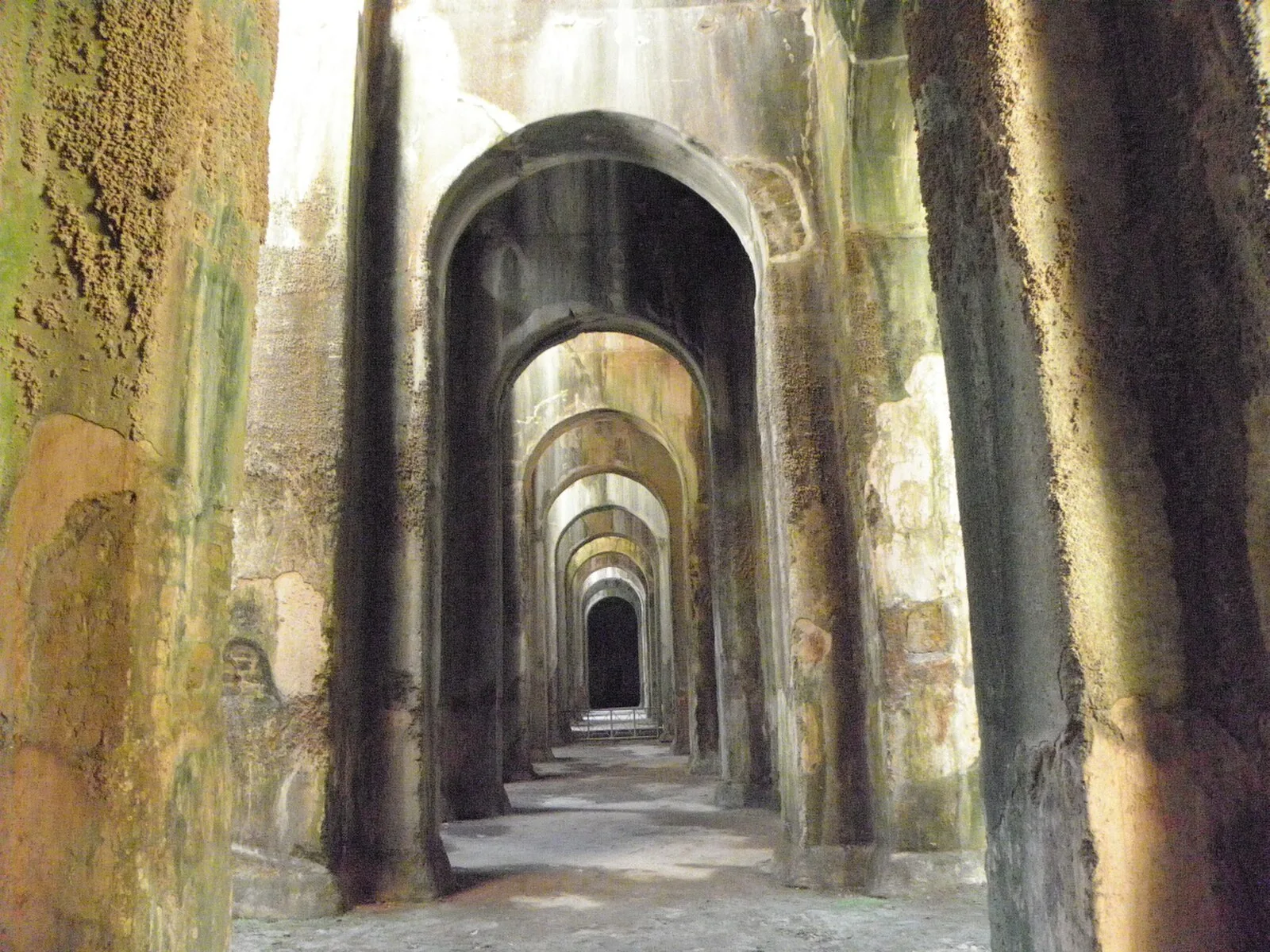
ItalyThe Piscina Mirabilis (Latin for "wondrous pool") is an Ancient Roman cistern on the Bacoli hill at the western end of the Gulf of Naples, southern Italy [1]. It ranks as one of the largest ancient cisterns built by the ancient Romans, compared to the largest Roman reservoir, the Yerebatan Sarayi (aka Basilica Cistern) in Istanbul [1]. The Piscina Mirabilis was supplied with water from the Aqua Augusta, built after 33 BC, which brought water to most of the sites around Naples [1]. The cistern was definitively out of use when the Aqua Augusta was destroyed between the 4th and 5th century AD [1]. Testament to its monumentality are the dimensions: 15 metres high, 72 metres long, and 25 metres wide [1]. The capacity is 12,600 cubic metres, amounting, in other words, to 12.6 million litres of water [1]. It was built as a kind of hypostyle hall on a quadrangular plan to obtain four rows of twelve cruciform pillars per row which divide the interior space into five long naves and thirteen courtyards [1].
Text: Wikipedia – 'Piscina Mirabilis' (revision of 2025-05-25), CC BY-SA 4.0 · sentences selected and shortened by an AI system · source →Piscina Mirabilis
Also known as: Piscina mirabile, Басейн Мірабіліс, Бассейн Мирабилис
| Type | Reservoir/aqueduct/canal |
|---|---|
| Period | 500 BC - 1 AD |
| Country | Italy |
| Coordinates | 40.7954° N, 14.0801° E |