
 Greece
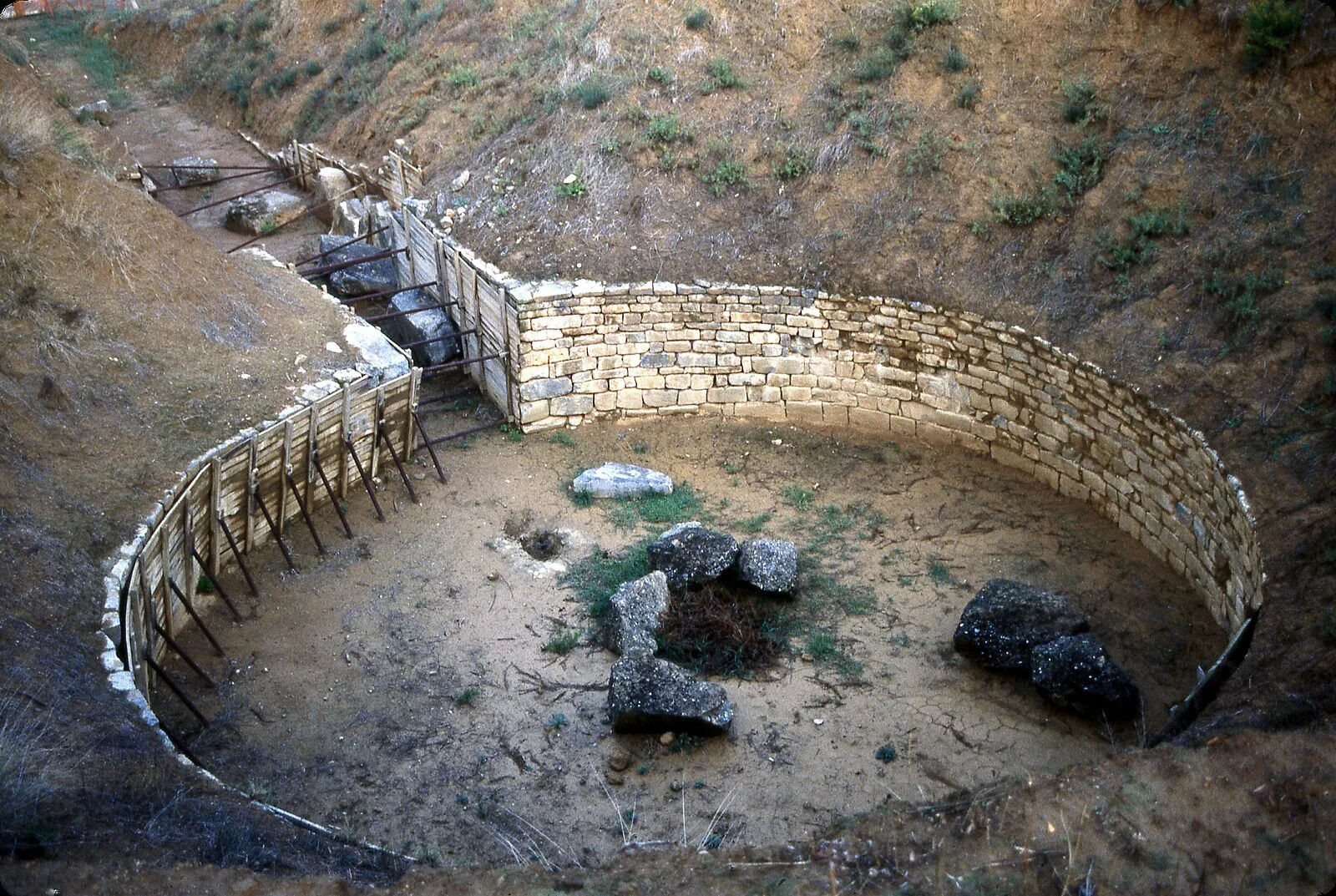
Vaphio, Vafio or Vapheio is an ancient site in Laconia, Greece, on the right bank of the Eurotas, some 5 mi (8.0 km) south of Sparta [1]. It is famous for its tholos or beehive tomb, excavated in 1889 by Christos Tsountas [1]. This consists of a walled approach, about 97 ft (30 m) long, leading to a vaulted chamber some 33 ft (10 m) in diameter, in the floor of which the actual grave was cut [1]. The main objects found there were transferred to the National Archaeological Museum of Athens [1]. The pottery in the tomb dates to around 1500 to 1450 BC, but the gold and carved gem seals might have been old when buried [1]. The objects include a large number of carved gem seals and amethyst beads, together with articles in gold, silver, bronze, iron, lead, amber and crystal [1]. By far the finest of the grave goods are a pair of golden cups decorated with scenes in relief, showing two different methods of capturing bulls, perhaps for the bull-leaping activities practised by the Minoan civilization of Crete, or for sacrifice [1].
Text: Wikipedia – 'Vaphio' (revision of 2026-09-07), CC BY-SA 4.0 · sentences selected and shortened by an AI system · source →Vaphio
Also known as: 바피오, Vafeio, Vafio, Vafio tholos, Vapheio, Vaphio beehive tomb, Vaphiói aranyserlegek, Βαφείο, Θολωτός τάφος Βαφειού, Вафио, ヴァフィオ, 瓦斐奥
| Type | Necropolis/tombs complex |
|---|---|
| Period | 3000 - 1500 BC |
| Country | Greece |
| Coordinates | 37.0224° N, 22.4609° E |