
 Greece
The Sanctuary of Artemis Orthia, an Archaic site devoted in Classical times to Artemis, was one of the most important religious sites in the Greek city-state of Sparta, and continued to be used into the fourth century CE [1]. The sanctuary is located in Peloponnese, on the south bank of the Eurotas River, at ancient Sparta [1]. The original sanctuary was believed to be built in ca. 700 BCE [1]. The cult of Orthia gave rise to διαμαστίγωσις / diamastigosis, where the éphēboi were flogged, as described by Plutarch, Xenophon, Pausanias, and Plato [1]. During the Roman period, according to Cicero, the ritual became a blood spectacle, sometimes to the death, with spectators from all over the empire [1]. Votive offerings found in the Sanctuary of Artemis Orthia were most often small but presented in large abundances [1]. The site was brought to light by the British School at Athens during their digs in Laconia (1906–10), after doll like figures and other tiny items were discovered in the ground around the river [1].
Text: Wikipedia – 'Sanctuary of Artemis Orthia' (revision of 2026-06-02), CC BY-SA 4.0 · sentences selected and shortened by an AI system · source →Sanctuary of Artemis Orthia
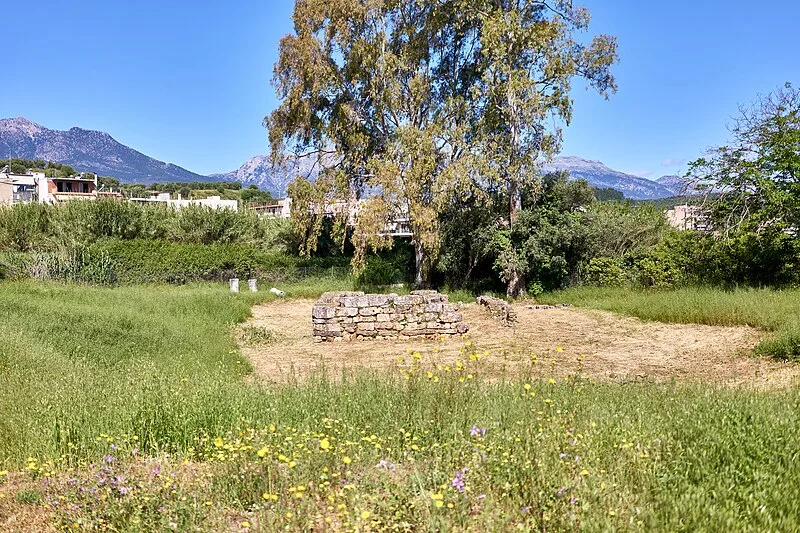
Also known as: Artemīdas Ortijas svētnīca, Artemis Orthian pyhäkkö, Artemis Orthias helgedom, heiligdom van Artemis Orthia, Heiligtum der Artemis Orthia, Heiligtum von Orthias Artemis, Ortheia sanctuary, Sanctuaire d'Artémis Orthia, sanctuaire d'Artémis Orthia à Sparte, Santuari d'Àrtemis Ortia, santuario de Artemisa Ortia, santuario di Artemide Ortia
| Type | Temple complex |
|---|---|
| Period | 1500 - 500 BC |
| Country | Greece |
| Coordinates | 37.0832° N, 22.4350° E |