
 Greece
The Stoa of Attalos was a stoa in the Agora of Athens, Greece [1]. It was built by and named after King Attalos II of Pergamon, who ruled between 159 and 138 BC [1]. The building was reconstructed from 1952 to 1956 by the American School of Classical Studies at Athens and currently houses the Museum of the Ancient Agora [1]. Typical of the Hellenistic age, the stoa was more elaborate and larger than the earlier buildings of ancient Athens and had two rather than the normal one storeys [1]. The stoa's dimensions are 115 by 20 metres and it is made of Pentelic marble and limestone [1]. The Doric order was used for the exterior colonnade on the ground floor with Ionic for the interior colonnade [1]. The building was constructed on the east side of the Agora or market place of Athens and was used from approximately 150 B.C. onwards for a variety of purposes [1]. The stoa was in frequent use until its woodwork was burned by the Heruli in AD 267 [1].
Text: Wikipedia – 'Stoa of Attalos' (revision of 2026-07-10), CC BY-SA 4.0 · sentences selected and shortened by an AI system · source →Stoa of Attalos
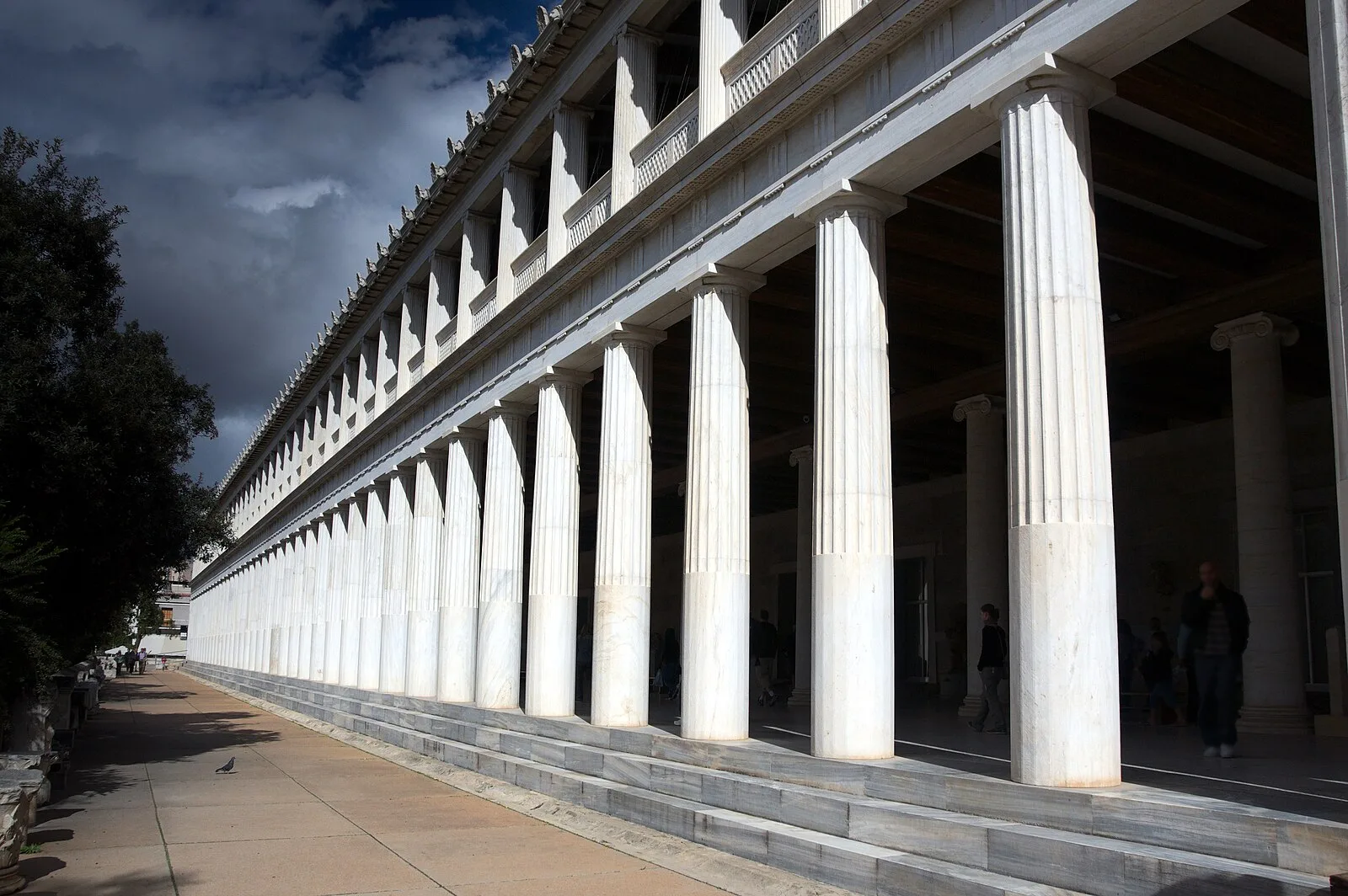
Also known as: 아탈로스의 스토아, Attaloksen stoa, Attalos-Stoa, Attalos Stoası, Estoa d'Àtal, Estoa de Atalo, Porticus Attali, Stoa Attalosa, stoà d'Àtal, Stoa d'Attale, Stoa de Átalo, Stoa des Attalos
| Type | Monument |
|---|---|
| Period | 500 BC - 1 AD |
| Country | Greece |
| Coordinates | 37.9752° N, 23.7242° E |