
 Greece
The South Stoa I of Athens was a two-aisled stoa located on the south side of the Agora, in Athens, Greece, between the Aiakeion and the Southeast Fountain House [1]. It probably served as the headquarters and dining rooms for various boards of Athenian officials [1]. It was built at the end of the 5th century BC and remained in use until the mid-second century BC, when it was replaced by South Stoa II [1]. The stoa stretched along most of the southern edge of the Classical Agora, facing north onto it [1]. The Stoa was 80.45 metres long east-west and 14.89 metres north-south [1]. It consisted of a two-aisled colonnade facing north and a set of fifteen rooms running along the back wall [1]. This became a common design for stoas, but South Stoa I appears to have been the earliest example [1]. The first traces were identified and excavated in 1936 under the direction of Eugene Vanderpool [1].
Text: Wikipedia – 'South Stoa I (Athens)' (revision of 2026-09-22), CC BY-SA 4.0 · sentences selected and shortened by an AI system · source →South Stoa I, Athens
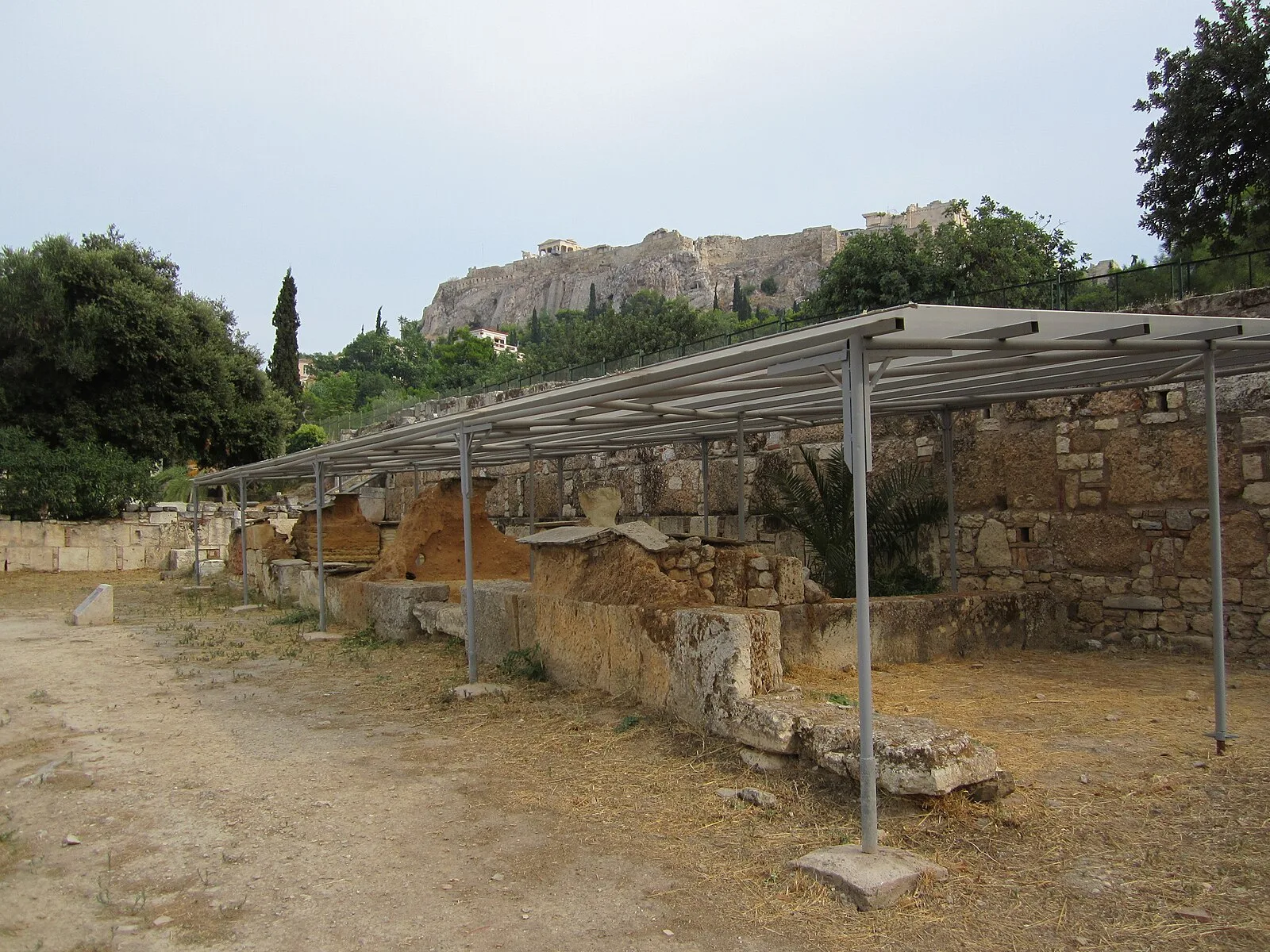
Also known as: Estoa sur I (Atenas), Etelästoa, Etelästoa (Ateena), South Stoa I, South Stoa I (Athens), Stoa sud, Stoà sud I, Stoa Sur I, Stoá sur I (Atenas), Νότια Στοά
| Type | Monument |
|---|---|
| Period | 500 BC - 1 AD |
| Country | Greece |
| Coordinates | 37.9746° N, 23.7231° E |