
 Greece
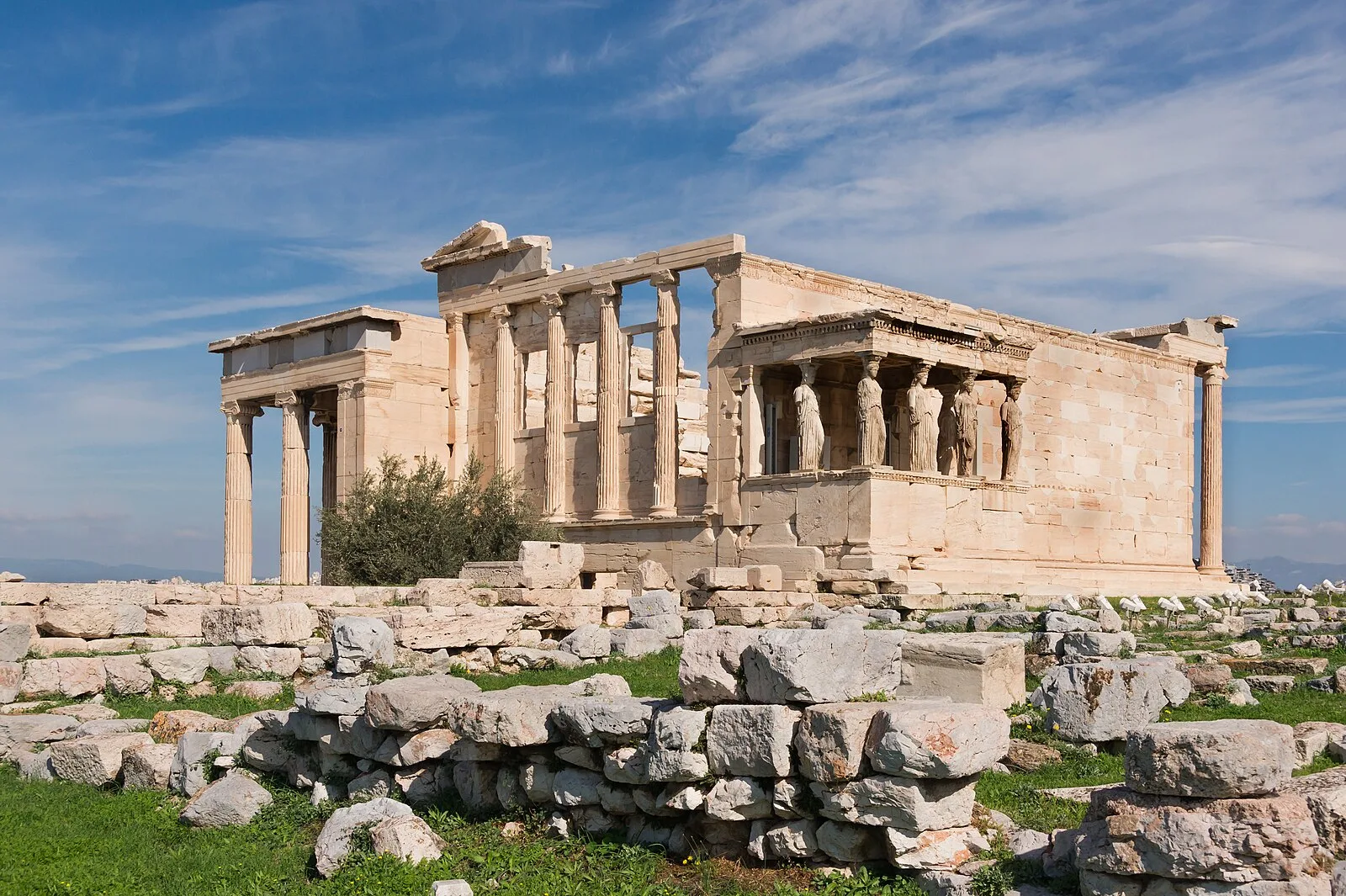
The Erechtheion or Temple of Athena Polias is an ancient Greek Ionic temple, on the north side of the Acropolis, Athens [1]. The extant building is the successor of several temples and buildings on the site [1]. Its precise date of construction is unknown; it has traditionally been thought to have been built from c. 421–406 BCE, but more recent scholarship favours a date in the 430s, when it could have been part of the programme of works instigated by Pericles [1]. The Erechtheion is unique in the corpus of Greek temples in that its asymmetrical composition does not conform to the canon of Greek classical architecture [1]. The classical Erechtheion is the last in a series of buildings approximately on the mid-north site of the Acropolis of Athens, the earliest of which dates back to the late Bronze Age Mycenaean period [1]. The entablature of the naos and north porch has a frieze of blue Eleusinian limestone that was decorated with white Pentelic marble figures attached by means of iron dowels [1].
Text: Wikipedia – 'Erechtheion' (revision of 2026-08-08), CC BY-SA 4.0 · sentences selected and shortened by an AI system · source →Erechtheion
Also known as: 에레크테이온, Erechteion, Erechtejon, Erechtejonas, Erechteum, Erechtheum, Erecteion, Erecteon, Erehteion, Ereĥteiono, Erehtej, Erehtejon
| Type | Temple complex |
|---|---|
| Period | 500 BC - 1 AD |
| Country | Greece |
| Coordinates | 37.9723° N, 23.7265° E |