
 Greece
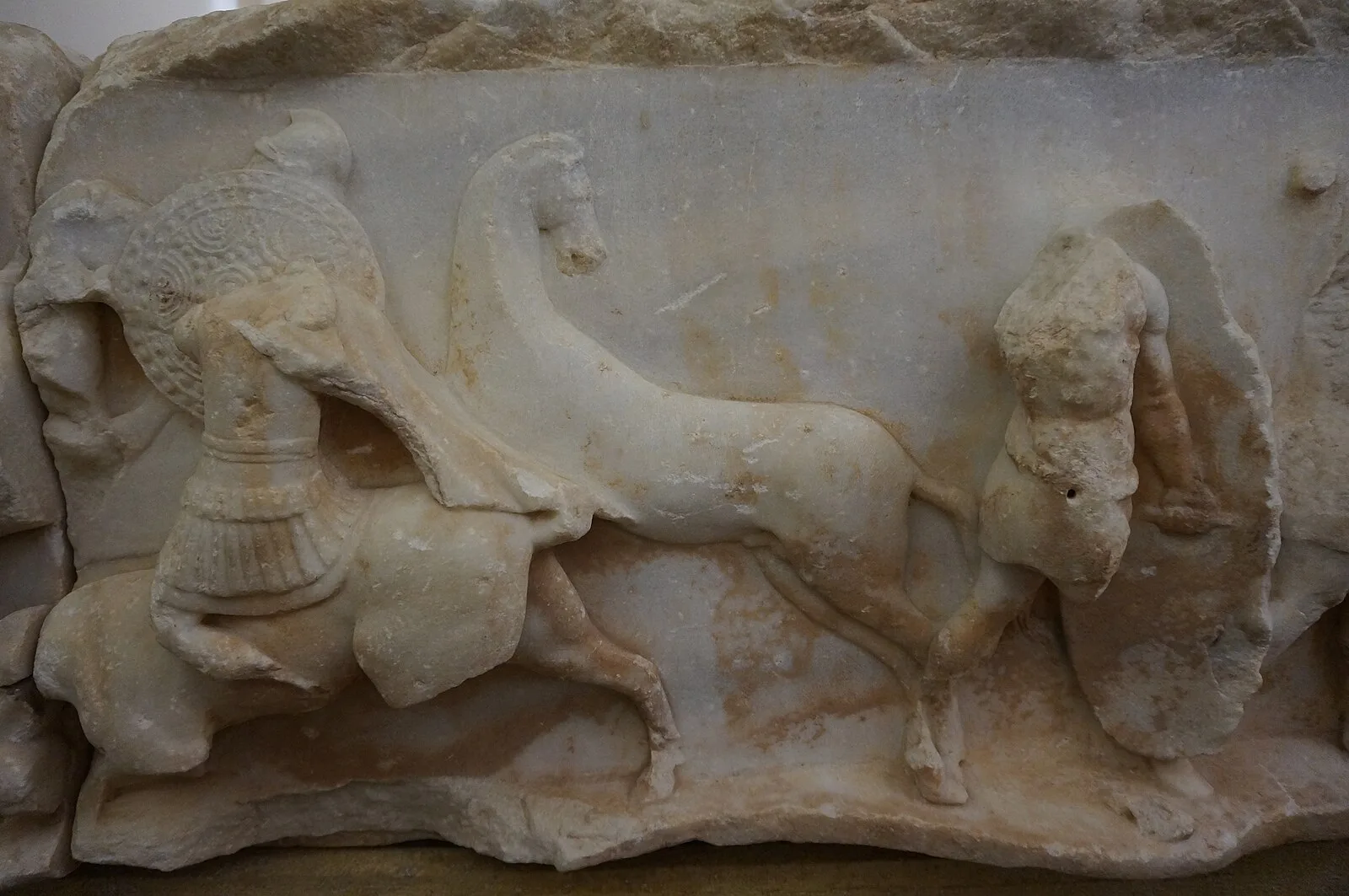
The Monument of Aemilius Paullus was erected in the Sanctuary of Apollo at Delphi shortly after 167 BCE in order to commemorate the Roman victory over King Perseus of Macedon at the Battle of Pydna [1]. It incorporated an incomplete pillar originally intended as a base for a portrait of King Perseus, which would have established the Macedonian presence in Delphi and reminded the Delphians of the tradition of friendship between them and the royal family [1]. The completed monument had a bronze equestrian statue that sat on top of a rectangular pillar over 9 meters high [1]. Deployed on all four sides at the top of the rectangular marble pillar is a relief frieze depicting the Battle of Pydna [1]. The frieze runs 6.5 meters long and 0.31 meters high [1]. The frieze is the earliest known example of Greek sculpture in a purely Roman context [1].
Text: Wikipedia – 'Monument of Aemilius Paullus' (revision of 2026-02-13), CC BY-SA 4.0 · sentences selected and shortened by an AI system · source →Monument of Aemilius Paullus
Also known as: Aemilius Paulluksen pylväs, Monumento a Emilio Paolo, Monumentul lui Aemilius Paullus
| Type | Monument |
|---|---|
| Period | 500 BC - 1 AD |
| Country | Greece |
| Coordinates | 38.4827° N, 22.5017° E |