
 Greece
The Kasta Tomb, also known as the Amphipolis Tomb, is the largest ancient tumulus ever discovered in Greece, and by comparison dwarfs that of Philip II of Macedon in Vergina [1]. It is an ancient Macedonian tomb of the last quarter of the 4th c. BC, and is enclosed in the Kasta mound near the ancient city of Amphipolis, Central Macedonia [1]. The first excavations at the mound in 1964 led to exposure of the perimeter wall, and further excavations in the 1970s uncovered many other ancient remains [1]. The inner tomb was first discovered in 2012 and entered in August 2014 [1]. The remains of five people were found in the tomb [1]. The tomb complex is surrounded by an almost circular wall of 158 m of diameter and 3 m height made of limestone covered with marble from the island of Thassos [1]. The burial mound is about 30 m high and 250,000 m3 of sand were needed to fill it [1]. The tomb consists of three chambers [1].
Text: Wikipedia – 'Kasta Tomb' (revision of 2026-08-19), CC BY-SA 4.0 · sentences selected and shortened by an AI system · source →Kasta Tomb
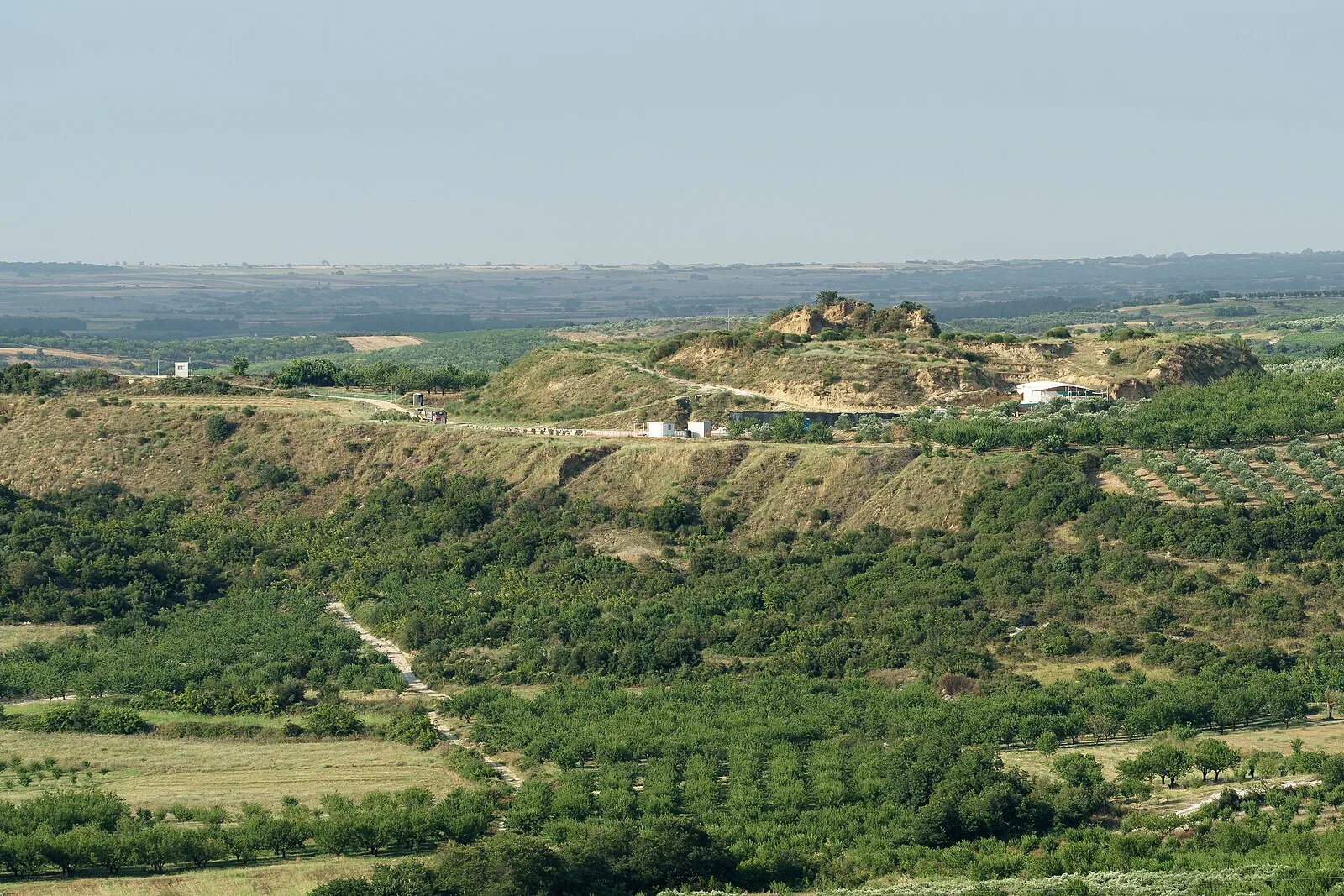
Also known as: Amphipolis tomb, Amphipolis tumulus, Anfipoliseko hilobia, Anfipolisen hilobia, Kasta-Grab, Kasta Grab Amphipolis, Kasta hilobia, Kastan hauta, Kasta Tombo, Kasta tumulus, Makam Kasta, Tomba d'Amfípolis
| Type | Necropolis/tombs complex |
|---|---|
| Period | 500 BC - 1 AD |
| Country | Greece |
| Coordinates | 40.8399° N, 23.8634° E |