
 Germany
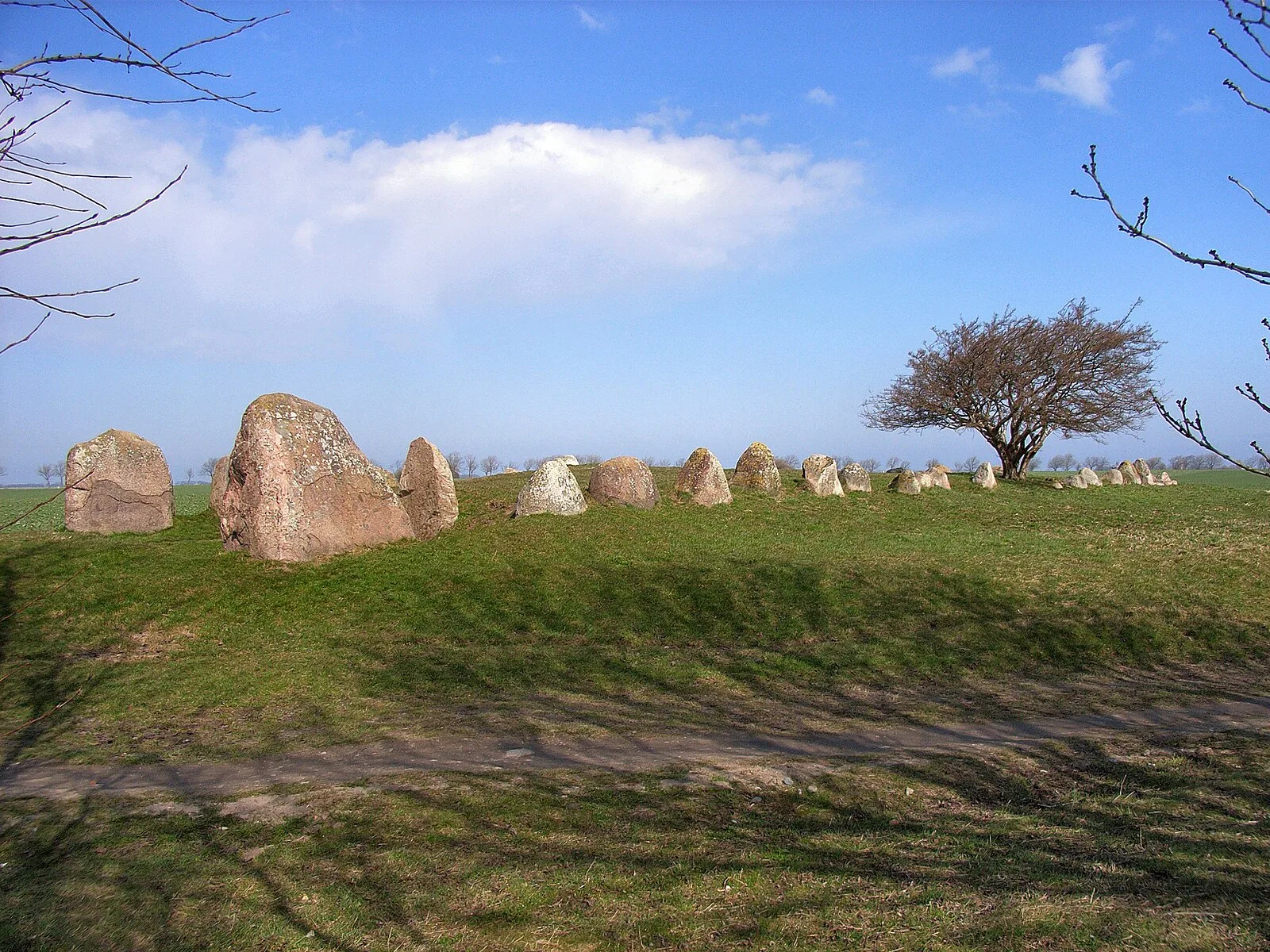
Nobbin is best known for the megalithic tomb known as the Riesenberg (also Großsteingrab Riesenberg) [1]. The tomb was constructed of glacial erratic boulders and dates back to the New Stone Age in Rügen [1]. It is one of the largest stone graves in North Germany and lies just a few metres from the steep coast on the bay of Tromper Wiek [1]. The trapezoidal enclosure, which originally had 53 large boundary stones, is 34 metres long and 8 to 11 metres wide (39 stones have survived) [1]. In the north-east were two transverse dolmens, of which only one is well preserved [1]. It is 1.4 metres high, 1.8 metres long and 1.1 metres wide [1].
Text: Wikipedia – 'Nobbin' (revision of 2026-05-09), CC BY-SA 4.0 · sentences selected and shortened by an AI system · source →Nobbin
| Type | Barrow |
|---|---|
| Period | 4500 - 3000 BC |
| Country | Germany |
| Coordinates | 54.6531° N, 13.3934° E |