
 Germany
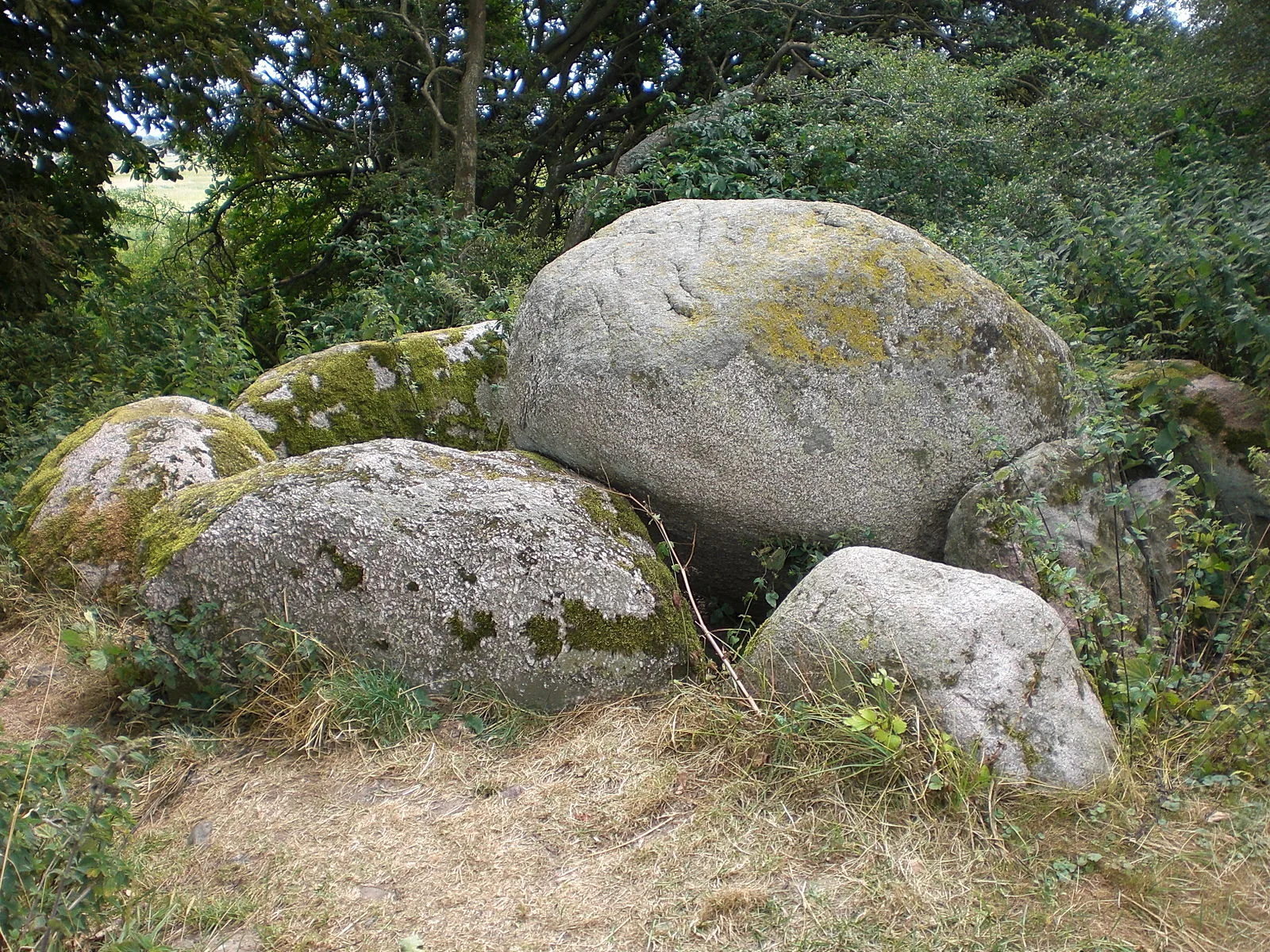
The Goldbusch is a great dolmen that lies between Altensien and Moritzdorf on the German Baltic Sea island of Rügen [1]. The megalithic tomb with Sprockhoff No. 508 was built between 3500 and 2800 BC in the New Stone Age as a megalithic site of the Funnelbeaker culture [1]. The burial chamber has two side walls each formed from three large supporting stones [1]. On these supporting uprights there were originally two capstones, only one of which has survived [1]. The burial chamber, which is oriented in an east-west direction, was originally completely covered by an earth mound and only accessible via a narrow passage at one end [1]. In 1969, an excavation of the Goldbusch tomb was carried out, led by Ewald Schuldt [1]. As well as flint arrowheads, six axes of the same material, a gouge, various shards of pottery and two decorated pottery jars were found [1].
Text: Wikipedia – 'Goldbusch' (revision of 2026-06-02), CC BY-SA 4.0 · sentences selected and shortened by an AI system · source →Goldbusch
| Type | Dolmen |
|---|---|
| Period | 4500 - 3000 BC |
| Country | Germany |
| Coordinates | 54.3593° N, 13.6817° E |