
 Germany
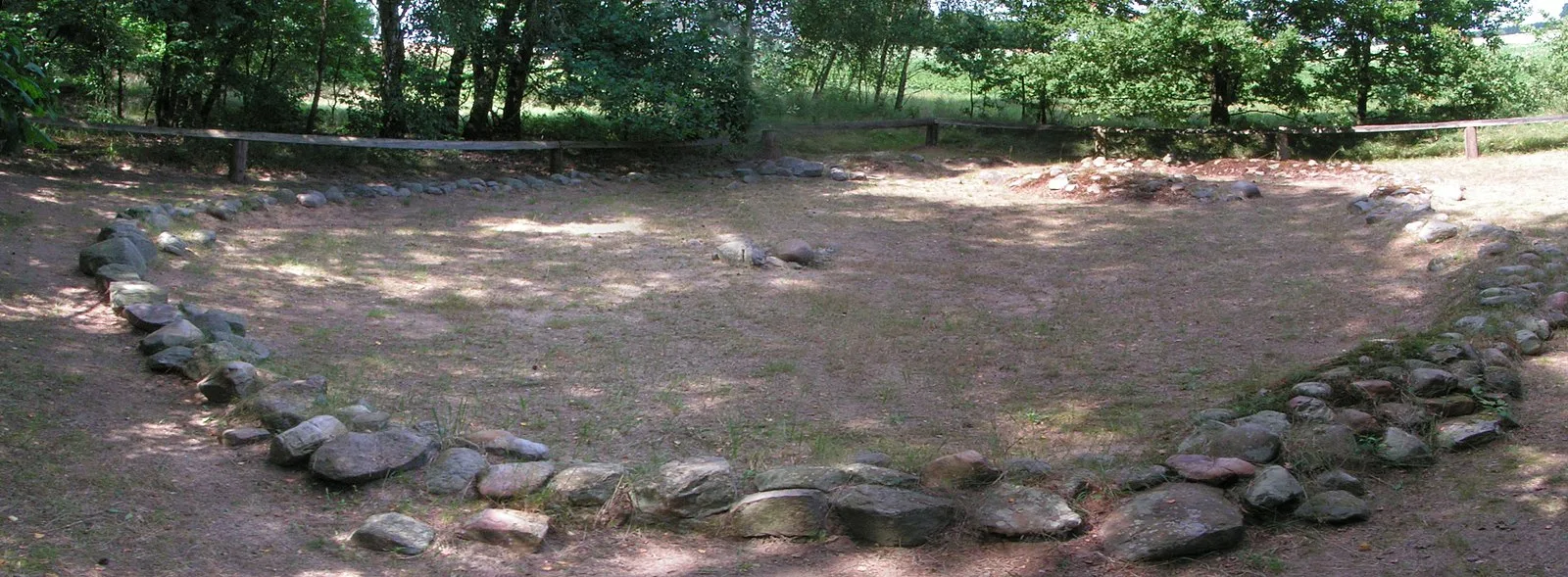
The Bonstorf Barrows are the remains of a much larger barrow cemetery on the Lüneburg Heath in north Germany dating to the late Neolithic or early Bronze Age [1]. They are located east of the village of Bonstorf, part of the municipality of Hermannsburg in the Lower Saxon district of Celle [1]. The site comprises six, closely packed burial mounds or barrows [1]. The largest barrow was located originally in a field, but due to its vulnerable location it was dug out in 1973 and reconstructed nearby [1]. Under the earth mound was a wooden chamber, in which a man had been buried in an east–west orientation [1]. Grave items included an earthenware jar, a palstave, a sword and a bronze dagger [1]. On the northern perimeter of the mound a woman was interred on a stone bed [1]. The grave finds are characteristic of the old Bronze Age (i.e. from about 1500 to 1200 BC) in the Lüneburg Heath [1].
Text: Wikipedia – 'Bonstorf Barrows' (revision of 2025-03-19), CC BY-SA 4.0 · sentences selected and shortened by an AI system · source →Bonstorf Barrows
Also known as: Gräberfeld von Bonstorf
| Type | Barrow |
|---|---|
| Period | 1500 - 500 BC |
| Country | Germany |
| Coordinates | 52.8641° N, 10.0647° E |