
 Germany
The dolmen on a low elevation between the villages of Dohnsen and Siddernhausen near the town of Bergen in North Germany, was originally 500 m further north [1]. It was excavated in 1977 and reconstructed in its present location [1]. This dolmen from the New Stone Age is believed to have been destroyed in the 17th or 18th century, because its large stones lay scattered on the fields [1]. Several of the stones were sunk into the ground, others had been carried away [1]. Excavations revealed that the burial chamber originally comprised 20 to 24 upright stones and about 8 capstones [1]. It had a side entrance; this type of grave is known as a passage grave [1]. The open space between the uprights and the capstones was sealed in with dry stonework [1]. The dead were laid on the floor of the burial chamber and prepared for the afterlife by being buried with their traditional jewellery, earthenware jars and everyday implements [1].
Text: Wikipedia – 'Dohnsen-Siddernhausen Dolmen' (revision of 2023-03-02), CC BY-SA 4.0 · sentences selected and shortened by an AI system · source →Dohnsen, Siddernhausen - Dolmen
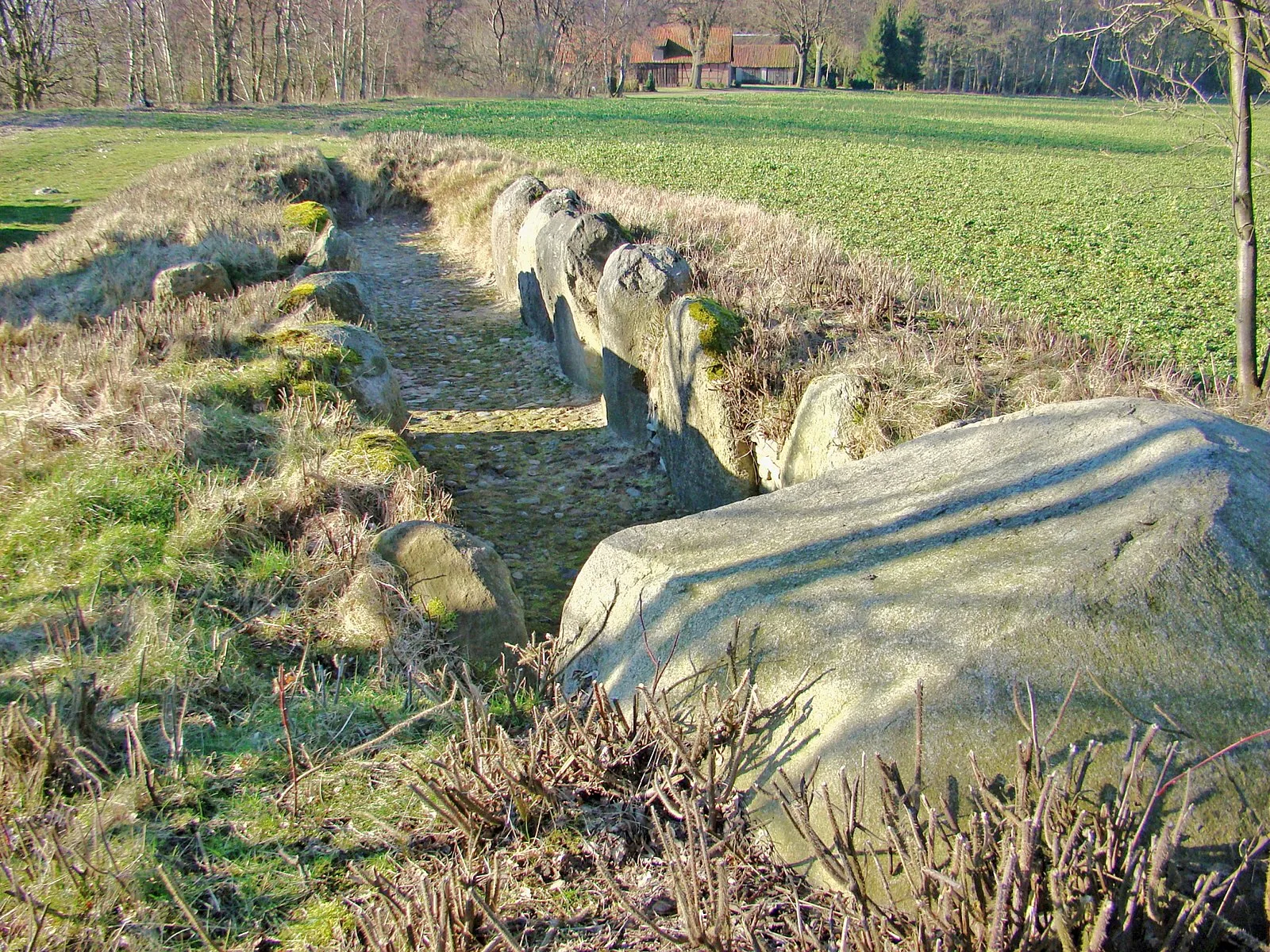
Also known as: Dohnsen-Siddernhausen Dolmen, Großsteingrab Dohnsen/Siddernhausen, Steinkammer bei Dohnsen, Донзен-Зиддернхаузенский дольмен
| Type | Dolmen |
|---|---|
| Period | 3000 - 1500 BC |
| Country | Germany |
| Coordinates | 52.8255° N, 10.0269° E |