
 France
The Alyscamps is a large Roman necropolis, which is a short distance outside the walls of the old town of Arles [1]. It was one of the most famous necropolises of the ancient world [1]. The Alyscamps was Arles' main burial ground for nearly 1,500 years [1]. It was the final segment of the Aurelian Way leading up to the city gates and was used as a burial ground for well-off citizens, whose memorials ranged from simple sarcophagi to elaborate monuments [1]. The Alyscamps continued to be used after the city was Christianised in the 4th century [1]. Saint Genesius, a Roman civil servant beheaded in 303 for refusing to follow orders to persecute Christians, was buried there and rapidly became the focus of a cult [1]. The area became a highly desirable place to be buried and tombs soon multiplied [1]. As early as the 4th century there were already several thousand tombs, necessitating the stacking of sarcophagi three layers deep [1].
Text: Wikipedia – 'Alyscamps' (revision of 2026-07-18), CC BY-SA 4.0 · sentences selected and shortened by an AI system · source →Alyscamps
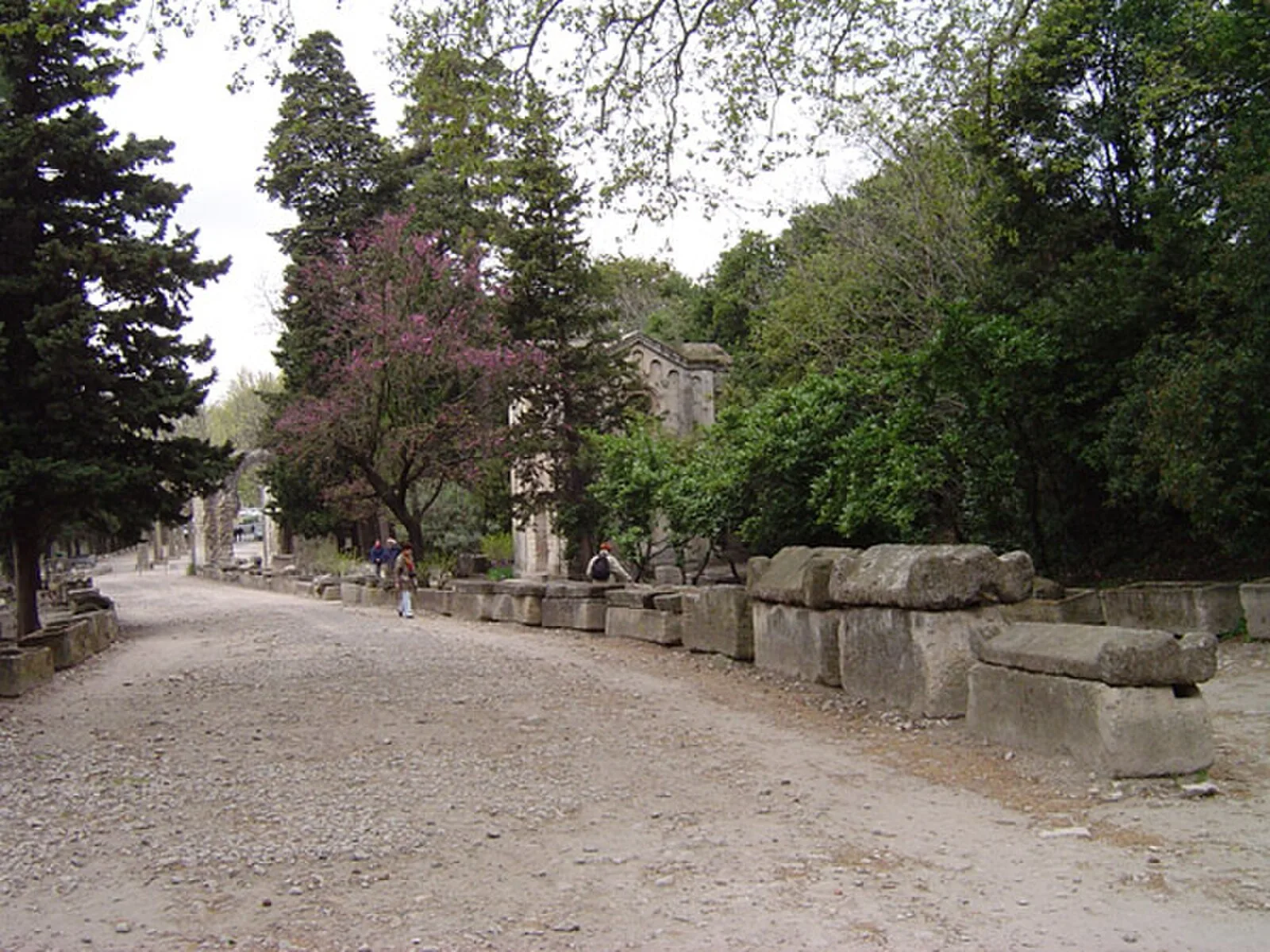
Also known as: Aliscamps, Aliscamps (Arle), Campi elisi, Die Aliscamps, Die Alyscamps, Les Aliscamps, Les Alyscamps, The Aliscamps, The Alyscamps, Алискам, アリスカン, 阿利斯康
| Type | Necropolis/tombs complex |
|---|---|
| Period | 1500 - 500 BC |
| Country | France |
| Coordinates | 43.6733° N, 4.6340° E |