
 France
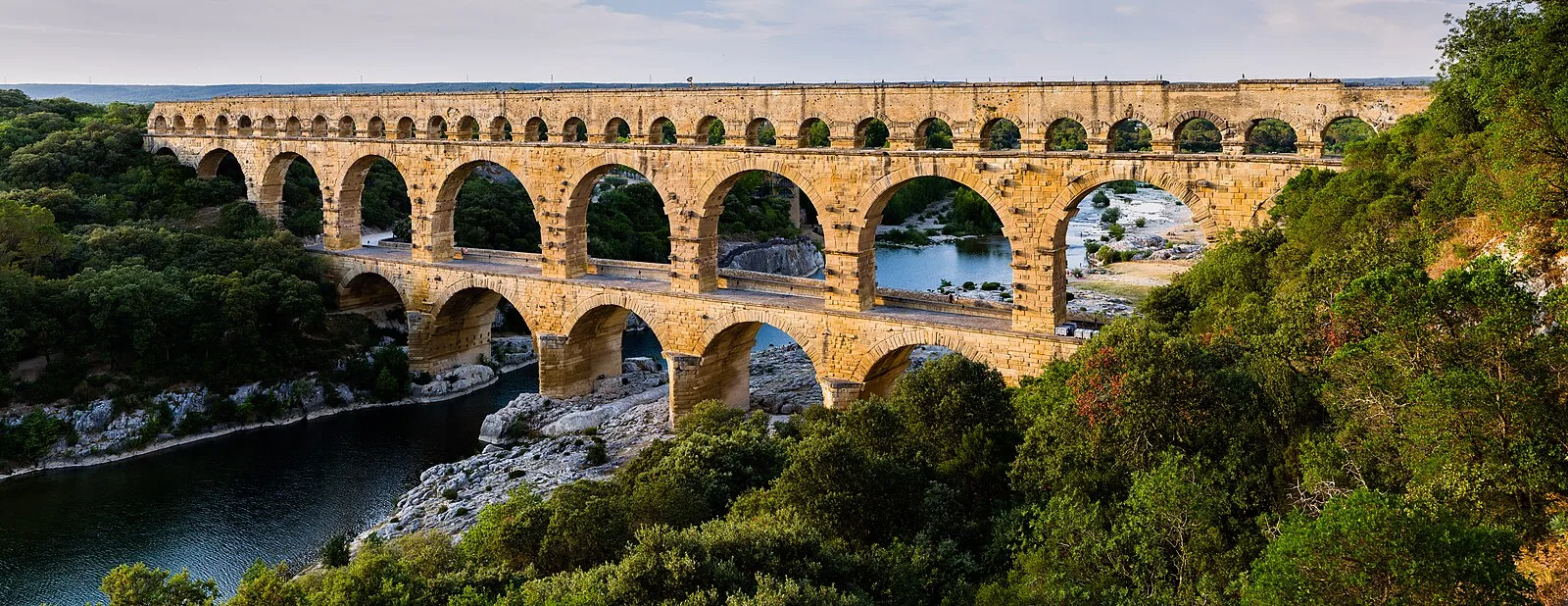
The Pont du Gard is one of the best preserved Roman aqueduct bridges [1]. The bridge has three tiers of arches made from Shelly limestone and stands 48.8 m high [1]. The structure's precise construction allowed an average gradient of 1 cm in 182.4 m [1]. It may have been in use as late as the 6th century, with some parts used for significantly longer, but lack of maintenance after the 4th century led to clogging by mineral deposits and debris that eventually stopped the flow of water [1]. After the Roman Empire collapsed and the aqueduct fell into disuse, the Pont du Gard remained largely intact with a secondary function as a toll bridge [1].
Text: Wikipedia – 'Pont du Gard' (revision of 2026-09-11), CC BY-SA 4.0 · sentences selected and shortened by an AI system · source →Pont du Gard
Also known as: 가르교, Akwedukt Pont-du-Gard, Cầu Gard, De Pont du Gard, Gardo tiltas, Gardský most, Gard tɛ kondoloko, Garo tiltas, Jembatan Gard, Le Pont du Gard, Pont ar Gard, Pònt de Gard
| Type | Bridge |
|---|---|
| Period | 1 - 500 AD |
| Country | France |
| Coordinates | 43.9477° N, 4.5355° E |