
 France
Argentovaria, also known as Ödenburg, is the collective term for a late Roman military installation and a civilian settlement in the area of Biesheim in Alsace [1]. The ancient sites of Biesheim-Kunheim and Ödenburg-Altkirch owe their importance to their position at an important crossing over the Rhine [1]. In the 1st and the 4th centuries AD the area was dominated by the military, but in the 2nd and 3rd centuries AD, the civilian settlement came to the fore [1]. Around the year 150 Ptolemy referred to the civil settlement of Argentovaria as the "second polis" of the Celtic Rauraci people after Augusta Raurica [1]. A Roman military base had existed in Biesheim since the 1st century AD [1]. The finds of oysters and fish from the Mediterranean as well as the remains of a bottle gourd from Africa speak to the far-reaching trade relations of the inhabitants of Argentovaria [1].
Text: Wikipedia – 'Argentovaria' (revision of 2025-06-26), CC BY-SA 4.0 · sentences selected and shortened by an AI system · source →Argentovaria
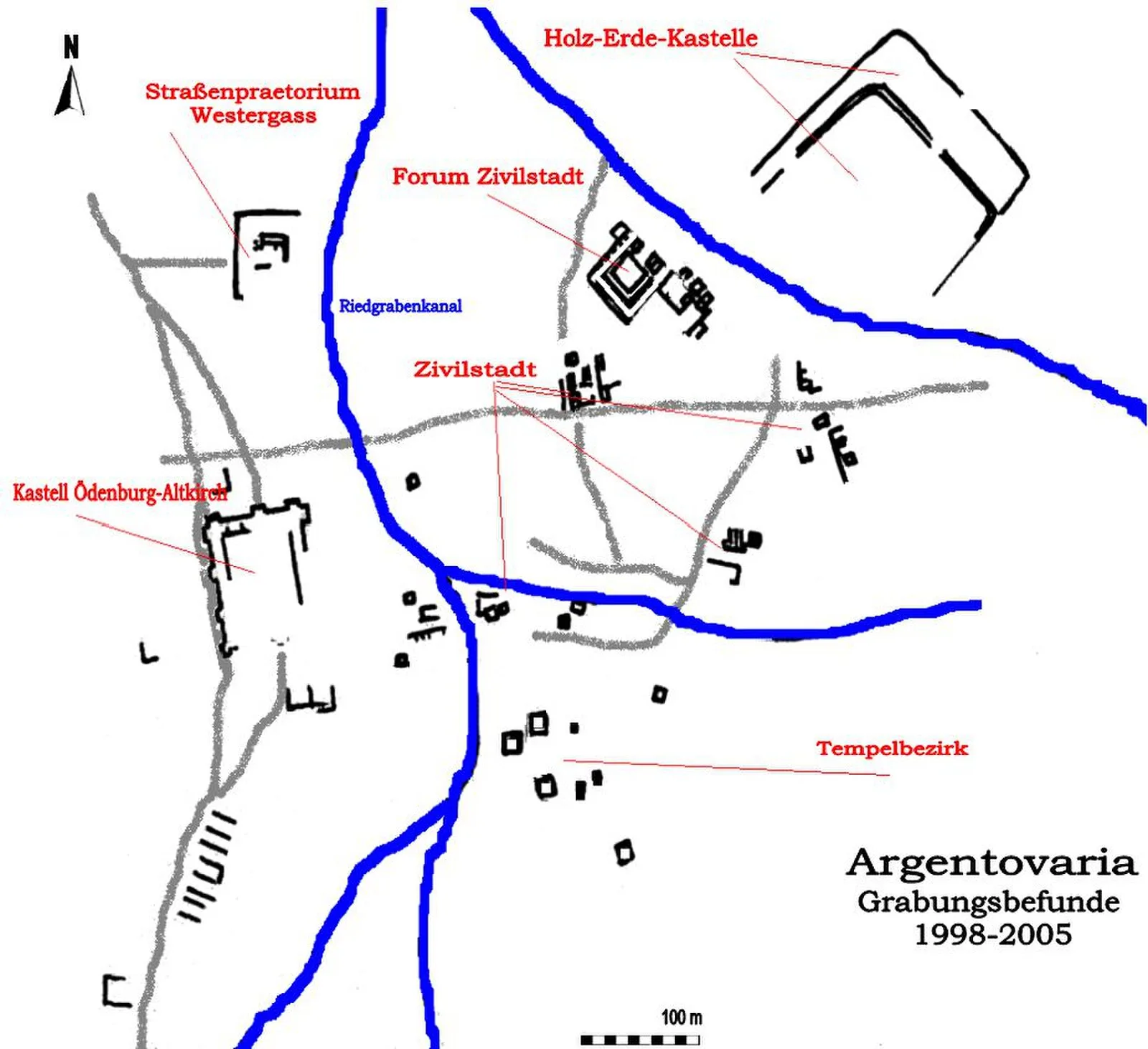
Also known as: Castra Argentovaria, Castra of Biesheim, Kastell Ödenburg-Altkirch, Kastell Oedenburg-Altkirch, Vicus gallo-romain de l'Oedenbourg
| Type | City/town/settlement |
|---|---|
| Period | 1 - 500 AD |
| Country | France |
| Coordinates | 48.0601° N, 7.5386° E |