
 France
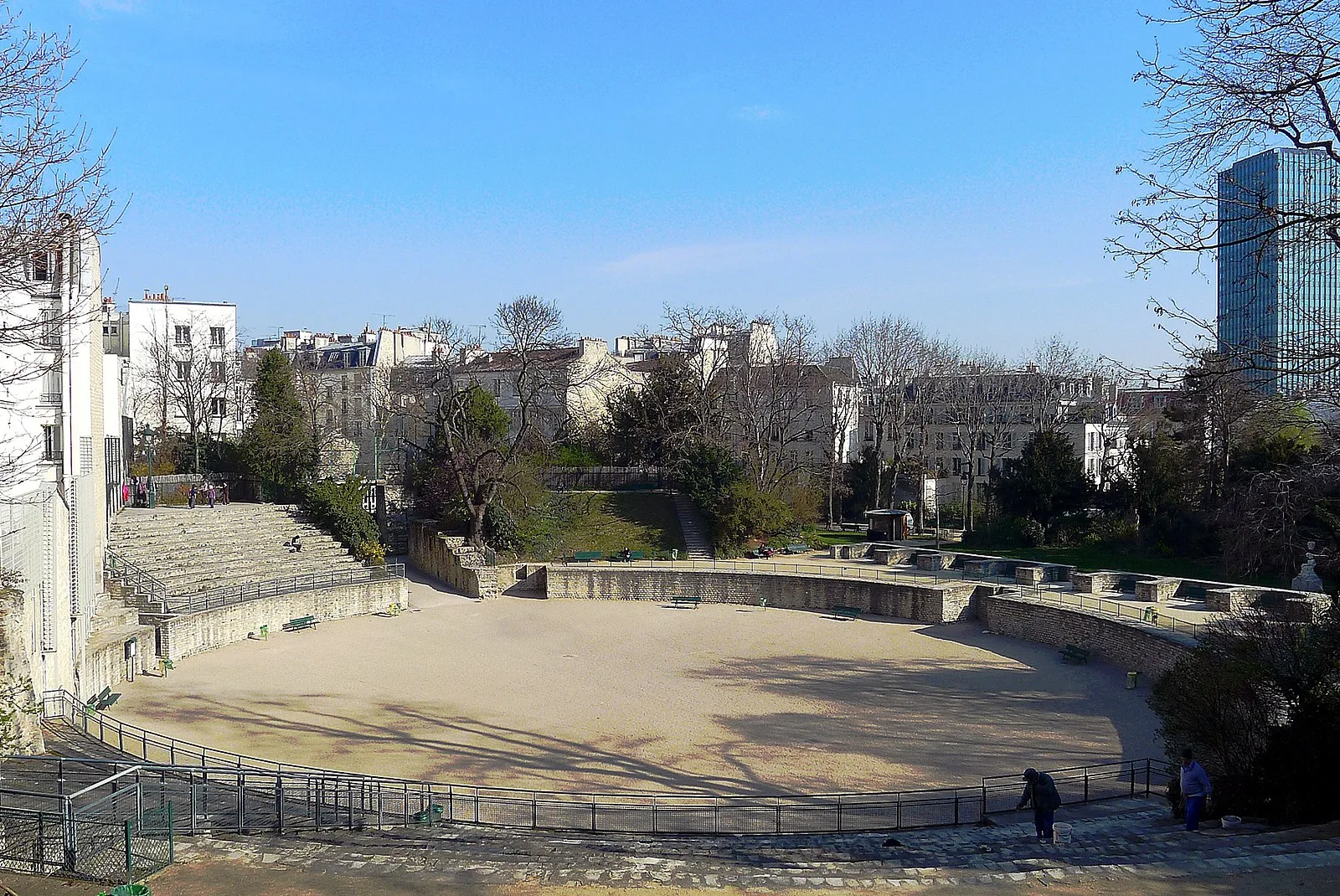
The Arènes de Lutèce are among the most important ancient Roman remains in Paris (known in antiquity as Lutetia) [1]. Constructed in the 1st century AD, this theatre could once seat 15,000 people and was used also as an amphitheatre to show gladiatorial combats [1]. Five small rooms were situated beneath the lower terraces, some of which appear to have been animal cages that opened directly into the arena [1]. When Lutetia was sacked during the barbarian raids of 275, some of the structure's stone work was used to reinforce the city's defences around the Île de la Cité [1]. Subsequently, the theatre became a cemetery, and was filled in completely following the construction of wall of Philippe Auguste (ca. 1210) [1]. Centuries later, even though the surrounding neighbourhood had retained the name les Arènes, the exact location was lost [1]. It was discovered by Théodore Vaquer during the building of the Rue Monge between 1860 and 1869 [1].
Text: Wikipedia – 'Arènes de Lutèce' (revision of 2026-07-21), CC BY-SA 4.0 · sentences selected and shortened by an AI system · source →Arènes de Lutèce
Also known as: 루테티아의 원형 경기장, 루테티아 아레나, 아렌 드 루테스, 아렌 드 뤼테스, Aréna Lutetia, Arenas de Lutecia, Arena van Lutetia, Arena von Lutetia, Arènes de Lutèche, Đấu trường Lutèce, Đấu trường Lutetia, Αρένα της Λουτέτιας
| Type | Amphitheatre |
|---|---|
| Period | 1 - 500 AD |
| Country | France |
| Coordinates | 48.8451° N, 2.3528° E |