
 England
Yarnbury Castle is the site of a multiphase, multivallate Iron Age hillfort near the village of Steeple Langford, Wiltshire [1]. The site covers an area of 28.5 acres, and was extensively surveyed and investigated by the Royal Commission on the Historical Monuments of England in 1991, with finds of Iron Age and Romano-British pottery, Iron Age and Roman coins, and burials of human remains [1]. There is much evidence of prolonged and extensive settlement of the site, including evidence of around 130 structures of various sizes, most probably representing a mix of round houses, pits, and other features [1]. It was designated as a scheduled monument in 1925 [1]. The earthworks at Yarnbury consist of three ramparts with outer ditches [1]. In the centre of the hillfort lies an earlier and smaller single banked enclosure of 5.2 ha in area [1]. The main earthworks are thought to date from around 100 BC, with the earlier inner circuit being from about 300 BC, according to pottery finds from early Iron Age through to Romano-British, including Samian of around 160 AD [1].
Text: Wikipedia – 'Yarnbury Castle' (revision of 2026-07-27), CC BY-SA 4.0 · sentences selected and shortened by an AI system · source →Yarnbury Castle
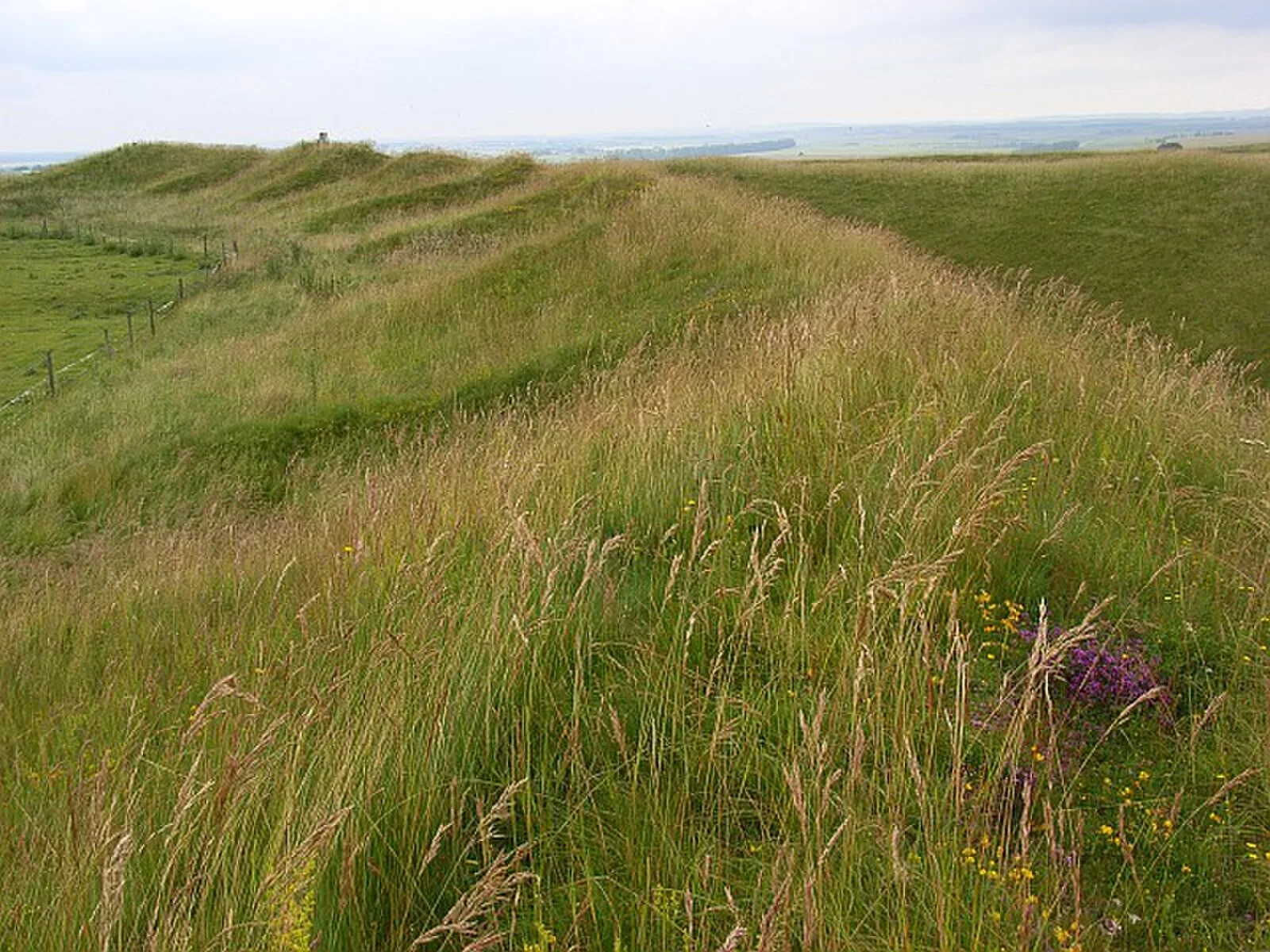
Also known as: Yarnbury Camp
| Type | Fortress/citadel |
|---|---|
| Period | 500 BC - 1 AD |
| Country | England |
| Coordinates | 51.1632° N, 1.9510° W |