
 England
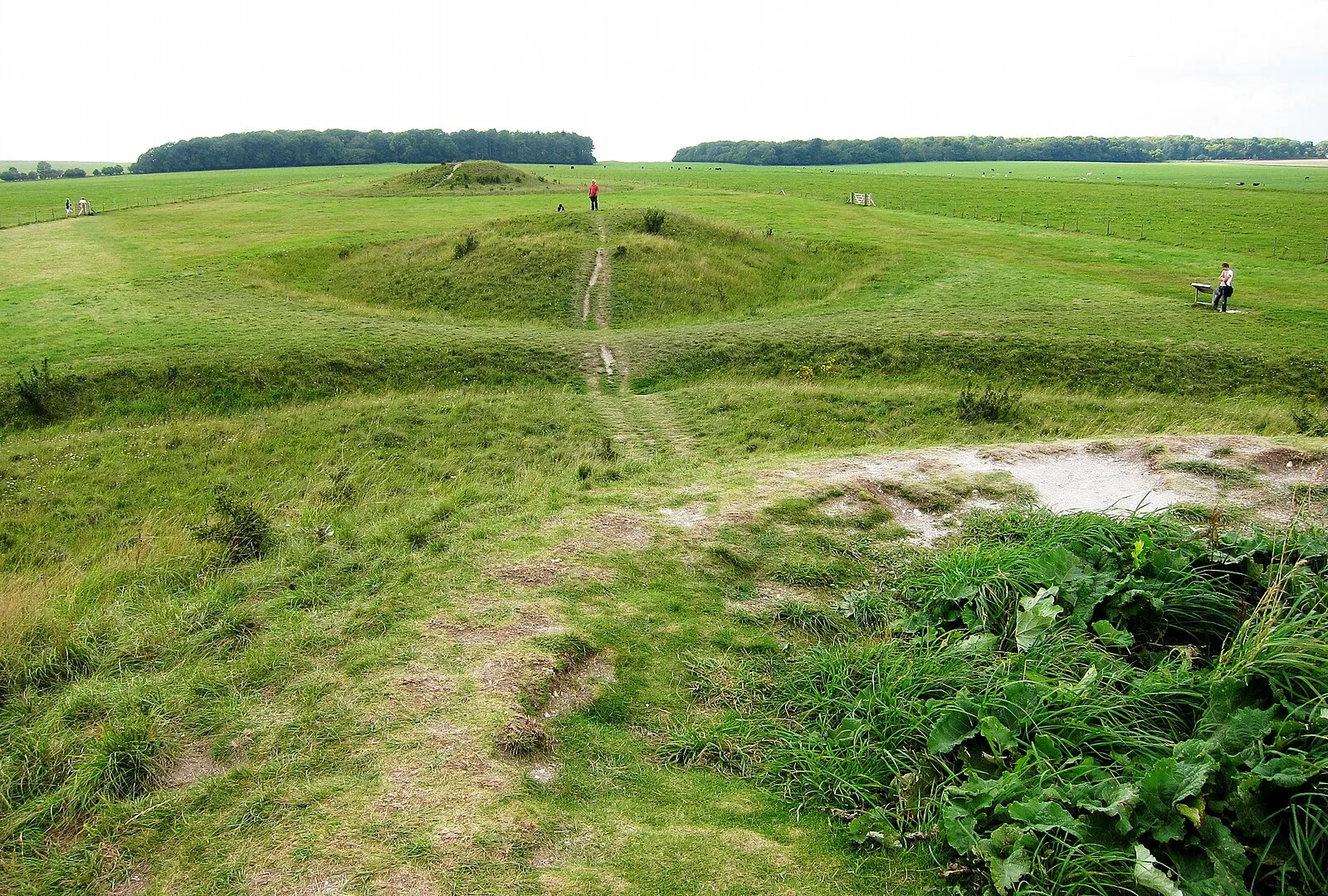
The Cursus Barrows is the name given to a Neolithic and Bronze Age round barrow cemetery lying mostly south of the western end of the Stonehenge Cursus, in Wiltshire [1]. The cemetery contains around 18 barrows scattered along an east-to-west ridge, although some of the mounds are no longer visible [1]. The round barrow cemetery extends 1200 metres east-to-west along a ridge and measures 250 metres wide [1]. It comprises the round barrows recorded as Amesbury 43 to 56 and Winterbourne Stoke 28 to 30, plus the Fargo hengiform [1]. Many of the barrows were excavated by Richard Colt Hoare in the early 19th century [1]. Amesbury 43 and 44 are a bell barrow and a twin bell barrow forming the eastern part of the Cursus round barrow cemetery [1]. When excavated in the early 19th century Amesbury 54 revealed a primary burial with a beaker, flint spear head and polished hammer head [1].
Text: Wikipedia – 'Cursus Barrows' (revision of 2026-07-18), CC BY-SA 4.0 · sentences selected and shortened by an AI system · source →Cursus Barrows
Also known as: רגמי הקרסוס
| Type | Barrow |
|---|---|
| Period | 4500 - 3000 BC |
| Country | England |
| Coordinates | 51.1831° N, 1.8369° W |