
 England
The site of Ebsbury, in Wiltshire, England, includes the remains of an Iron Age enclosed settlement, field system and possible hill fort, and a Romano-British enclosed settlement [1]. The site occupies the spur of a downland hill with the possible hill fort enclosure measuring approximately 700 m by 400 m, inside of which lie the remains of a field system with two further smaller oval enclosures and one triangular enclosure [1]. To the north and east sides of the site the contours of the hill have been reinforced by several banks [1]. The site of an Iron Age settlement lies to the eastern end of the site [1]. The site was subject to archaeological surveys and excavations in 1906 by S.W. Doughty [1]. Finds include a Neolithic perforated mace-head and two Roman coin hoards [1]. The latter were found buried in two earthenware pots; the coins date from between AD 337 and AD 408, and were found with the remains of a glass vessel, and six silver rings [1].
Text: Wikipedia – 'Ebsbury' (revision of 2026-07-18), CC BY-SA 4.0 · sentences selected and shortened by an AI system · source →Ebsbury
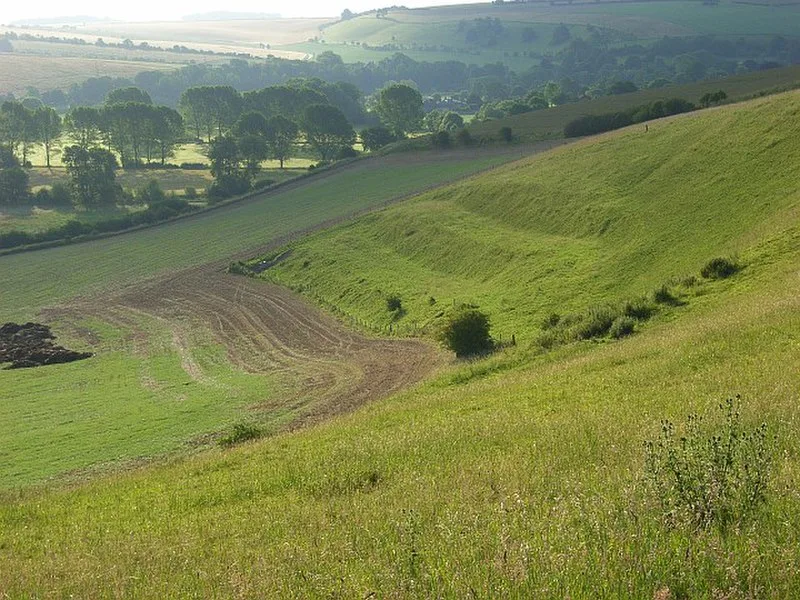
Also known as: Ebsbury Hill, Ebsbury or Grovely Earthworks
| Type | Fort |
|---|---|
| Period | 1500 - 500 BC |
| Country | England |
| Coordinates | 51.1181° N, 1.9120° W |