
 England
Silbury Hill is a prehistoric artificial chalk mound near Avebury in the English county of Wiltshire [1]. At 39.3 metres high, the hill is the tallest and second largest prehistoric man-made mound in Europe and one of the largest in the world; it is similar in volume to contemporary Egyptian pyramids [1]. Silbury Hill is part of the complex of Neolithic monuments around Avebury, which includes the Avebury Ring and West Kennet Long Barrow [1]. The mound is composed mainly of chalk and clay excavated from the surrounding area and stands 39.3 metres high and covers about 2 hectares [1]. The hill was constructed in several stages between c. 2400 and 2300 BC and displays immense technical skill and prolonged control over labour and resources [1]. Few prehistoric artifacts have been found on Silbury Hill: at its core there is only clay, flints, turf, moss, topsoil, gravel, freshwater shells, mistletoe, oak, hazel, sarsen stones, ox bones, and antler tines [1].
Text: Wikipedia – 'Silbury Hill' (revision of 2026-08-28), CC BY-SA 4.0 · sentences selected and shortened by an AI system · source →Silbury Hill
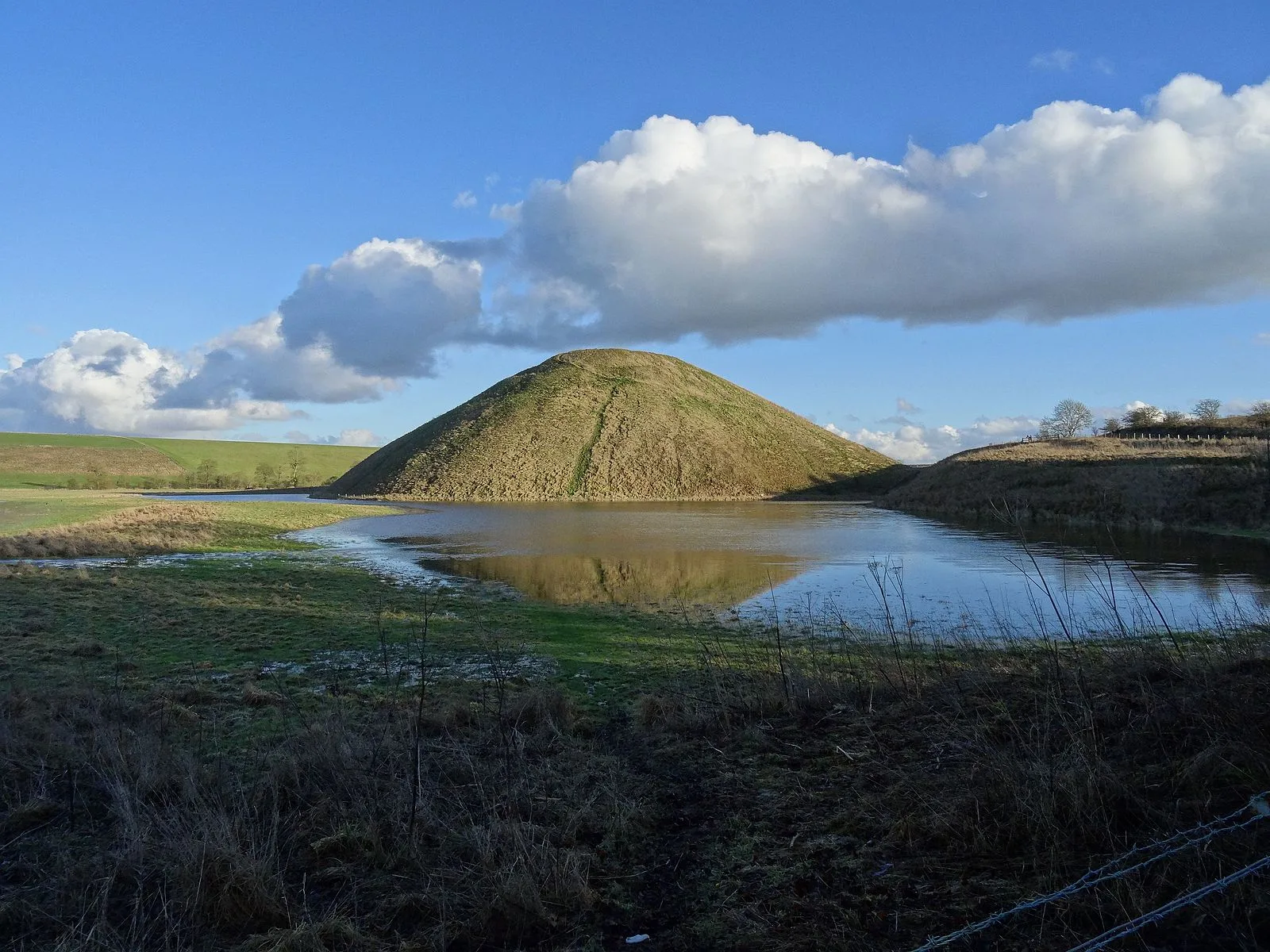
Also known as: Colina de Silbury, Silburyko muinoa, Silsbury Hill, Силбери-Хилл, גבעת סילברי, גבעת סִילְבְּרִי, சில்பரி மலை, シルバリー・ヒル, シルベリー・ヒル, 西爾布利山, 錫爾伯里丘
| Type | Mound/tumulus |
|---|---|
| Period | 3000 - 1500 BC |
| Country | England |
| Coordinates | 51.4158° N, 1.8574° W |