
 England
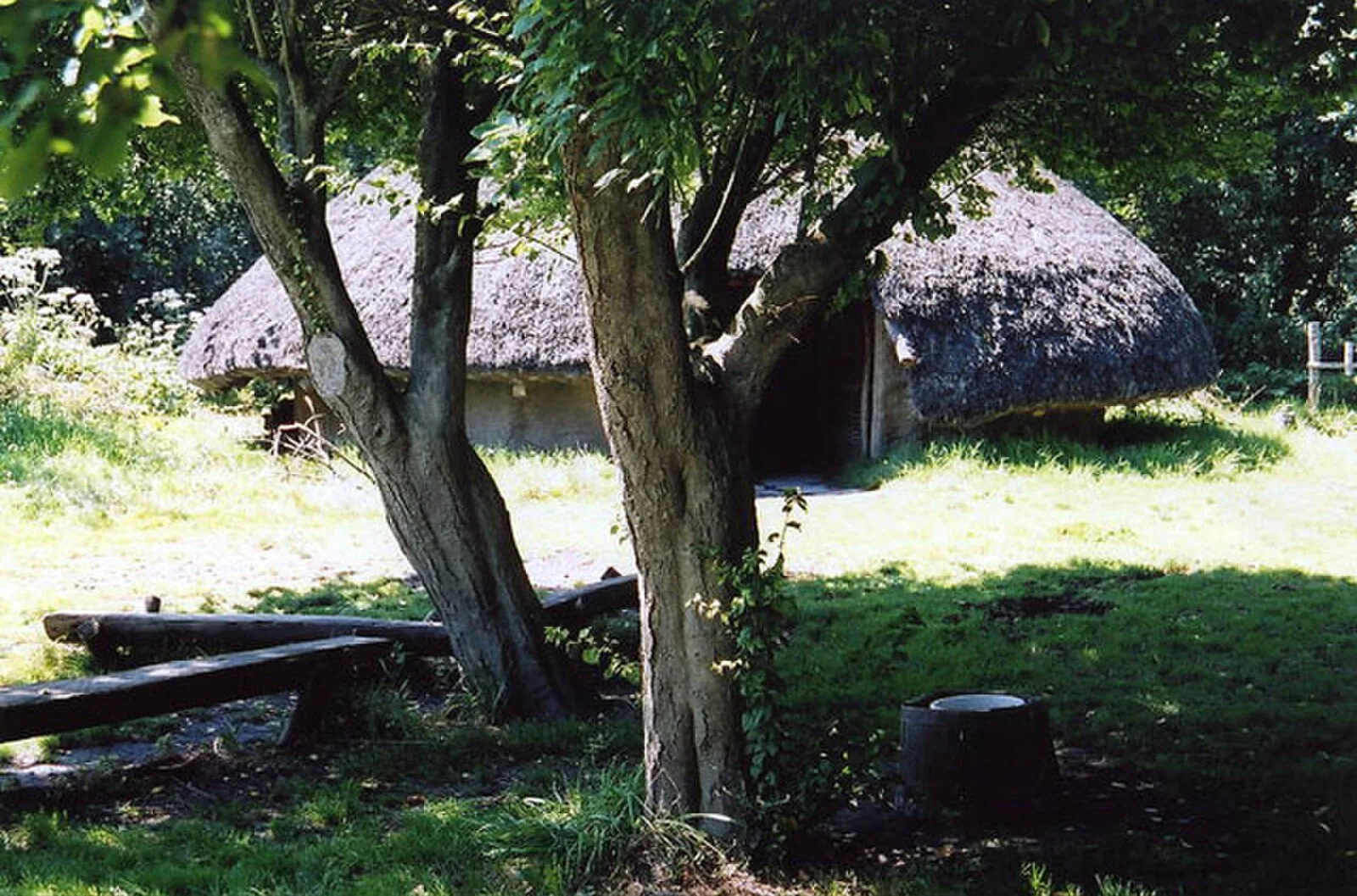
Glastonbury Lake Village was an Iron Age village, situated on a crannog or man made island in the Somerset Levels, near Godney, some 3 miles north west of Glastonbury in the southwestern English county of Somerset [1]. The site covered an area of 400 feet north to south by 300 feet east to west [1]. The site was discovered by Arthur Bulleid in 1892 and excavated over the next 15 years [1]. The village was first built circa 250 B.C. and occupied until approximately 50 B.C. when it was abandoned, possibly due to a rise in the water level [1]. It was built on a morass on an artificial foundation of timber filled with brushwood, bracken, rubble and clay [1]. The village housed people in five to seven groups of round houses, each for an extended family, with sheds and barns, made of hazel and willow covered with reeds, and surrounded either permanently or at certain times by a wooden palisade [1]. The site yielded a number of wooden objects preserved in the peaty soil including five wheel spokes and an unfinished nave to be used as the hub of a wheel [1].
Text: Wikipedia – 'Glastonbury Lake Village' (revision of 2026-08-09), CC BY-SA 4.0 · sentences selected and shortened by an AI system · source →Glastonbury Lake Village
Also known as: 格拉斯頓伯里湖泊村落
| Type | Village |
|---|---|
| Period | 500 BC - 1 AD |
| Country | England |
| Coordinates | 51.1637° N, 2.7258° W |