
 England
Beacon Hill, also known as Harting Beacon, is a hillfort on the South Downs, in the county of West Sussex in southern England [1]. The hilltop enclosure is dated to the Late Bronze Age, from the 8th to 6th centuries BC [1]. The hillfort defences were renewed during the Late Iron Age [1]. The fort extends approximately 400 metres east-west by approximately 500 metres north-south, and covers an area of approximately 10 hectares [1]. Archaeological investigations of the hillfort took place from 1948 to 1952, and from 1976 to 1977 [1]. As well as the Bronze Age remains, the area of the fort also includes an Anglo-Saxon burial mound, and the foundations of a late 18th-century telegraph station [1]. The hillfort is situated on the top of the hill and is defined by a single rampart and a flat-bottomed ditch, which survives as a low bank up to 6 metres wide [1]. The rampart was originally faced with timber, with timber palisades acting as retaining walls on both the inside and the outside [1].
Text: Wikipedia – 'Beacon Hill, West Sussex' (revision of 2025-03-09), CC BY-SA 4.0 · sentences selected and shortened by an AI system · source →Beacon Hill, West Sussex
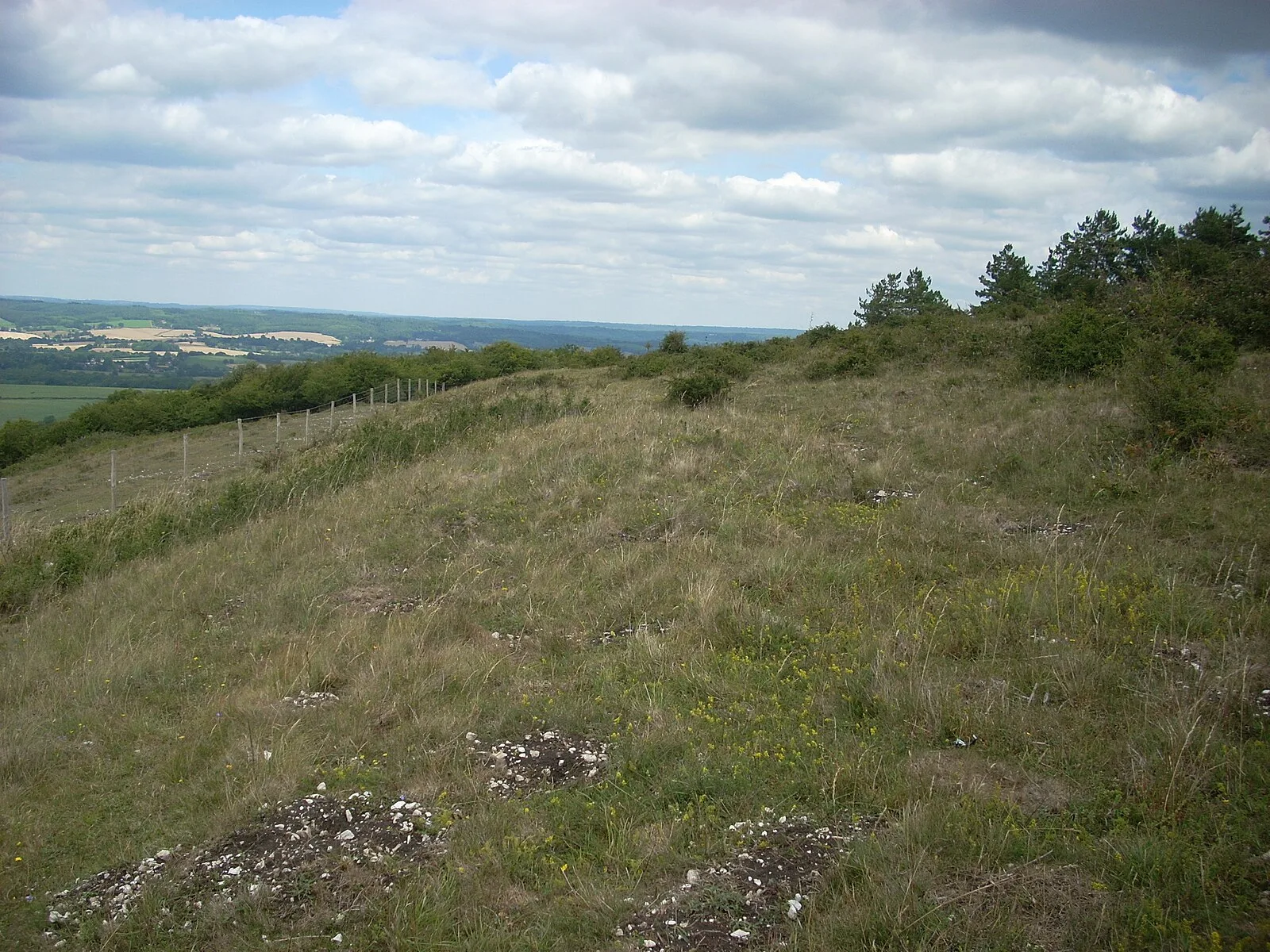
Also known as: Harting Beacon: a hilltop enclosure, Anglo-Saxon burial mound and telegraph station on Beacon and Pen Hills
| Type | Fortress/citadel |
|---|---|
| Period | 1500 - 500 BC |
| Country | England |
| Coordinates | 50.9591° N, 0.8519° W |