
 England
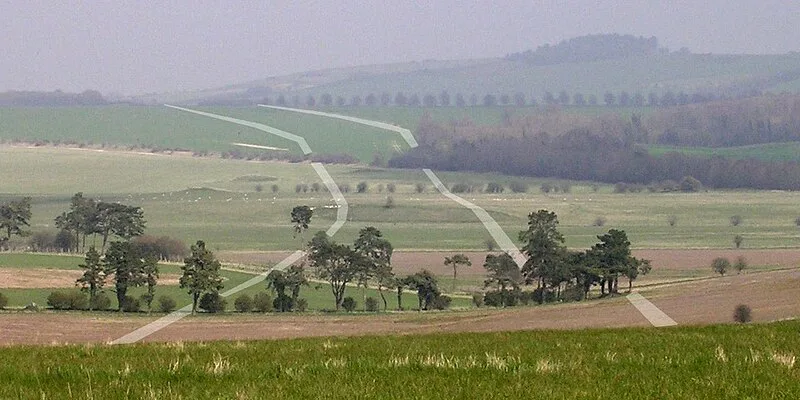
The Dorset Cursus is a Neolithic cursus monument that spans across 10 km of the chalk downland of Cranborne Chase in east Dorset, United Kingdom [1]. Its extreme length makes it a notable example of this class of linear earthwork; it is better interpreted as a pair of same-length cursus constructed end to end, with the more southerly cursus (the Gussage Cursus) pre-dating the northerly one (the Pentridge Cursus) [1]. The Cursus dates from 3300 BCE which makes it contemporary with the earthen long barrows on Cranborne Chase: many of these are found near, on, or within the Cursus and since they are still in existence they help trace the Cursus' course in the modern landscape [1]. The relationship between the Cursus and the alignment of these barrows suggests that they had a common ritual significance to the Neolithic people who spent an estimated 0.5 million worker-hours in its construction [1]. The Cursus consisted of a pair of parallel banks (1.5 m tall) running about 82 m apart, with external ditches 1.5 m deep and 2 m wide [1].
Text: Wikipedia – 'Dorset Cursus' (revision of 2025-04-04), CC BY-SA 4.0 · sentences selected and shortened by an AI system · source →Dorset Cursus
Also known as: Дорсетский курсус, كورس دورست
| Type | Earthwork |
|---|---|
| Period | 4500 - 3000 BC |
| Country | England |
| Coordinates | 50.9435° N, 1.9752° W |