
 Bolivia
Pachataka (also spelled Pachataca or Pachat'aqa), commonly known as the Inca Gallows, is an archaeological site in Bolivia, located near Lake Titicaca in the municipality of Copacabana, Manco Kapac Province [1]. Pachataka is a pre-Inca astronomical observatory formed by a lintel made of two parallel stone blocks [1]. It was used to determine the seasons, track lunar movements, and predict eclipses [1]. It is located at the summit of Mount Kesanani, approximately 600 meters south of the town of Copacabana [1]. According to mathematical and astronomical calculations conducted by the Institute of Cosmic Physics of Bolivia, the observatory dates approximately to 1764 B.C., during the era of the Chiripa culture [1].
Text: Wikipedia – 'Pachat'aqa' (revision of 2026-07-18), CC BY-SA 4.0 · sentences selected and shortened by an AI system · source →Pachat'aqa
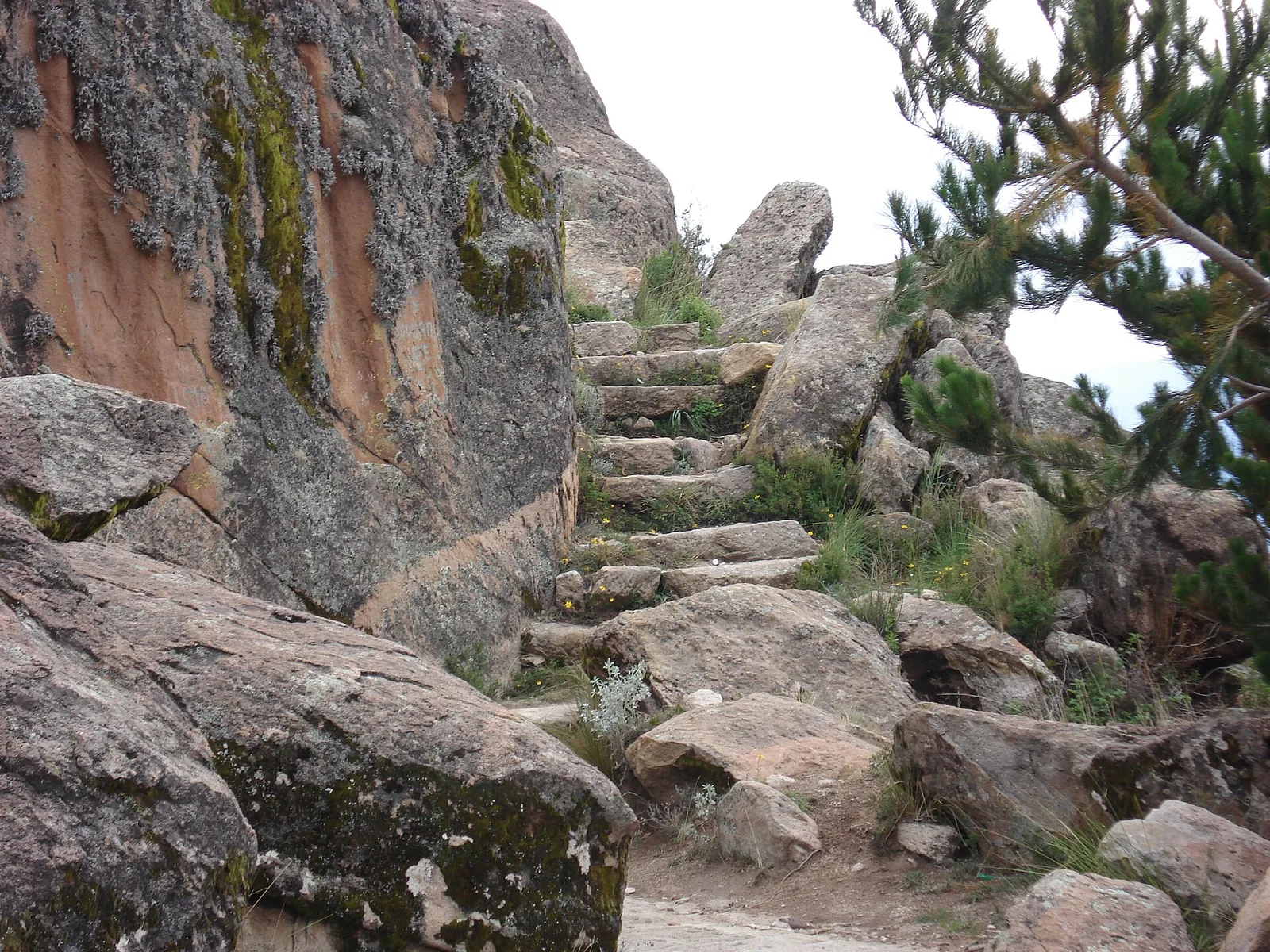
Also known as: Horca del Inca, La Horca del Inca, Pachataka
| Type | Archaeological site |
|---|---|
| Period | 3000 - 1500 BC |
| Country | Bolivia |
| Coordinates | 16.1716° S, 69.0849° W |