
 Sweden
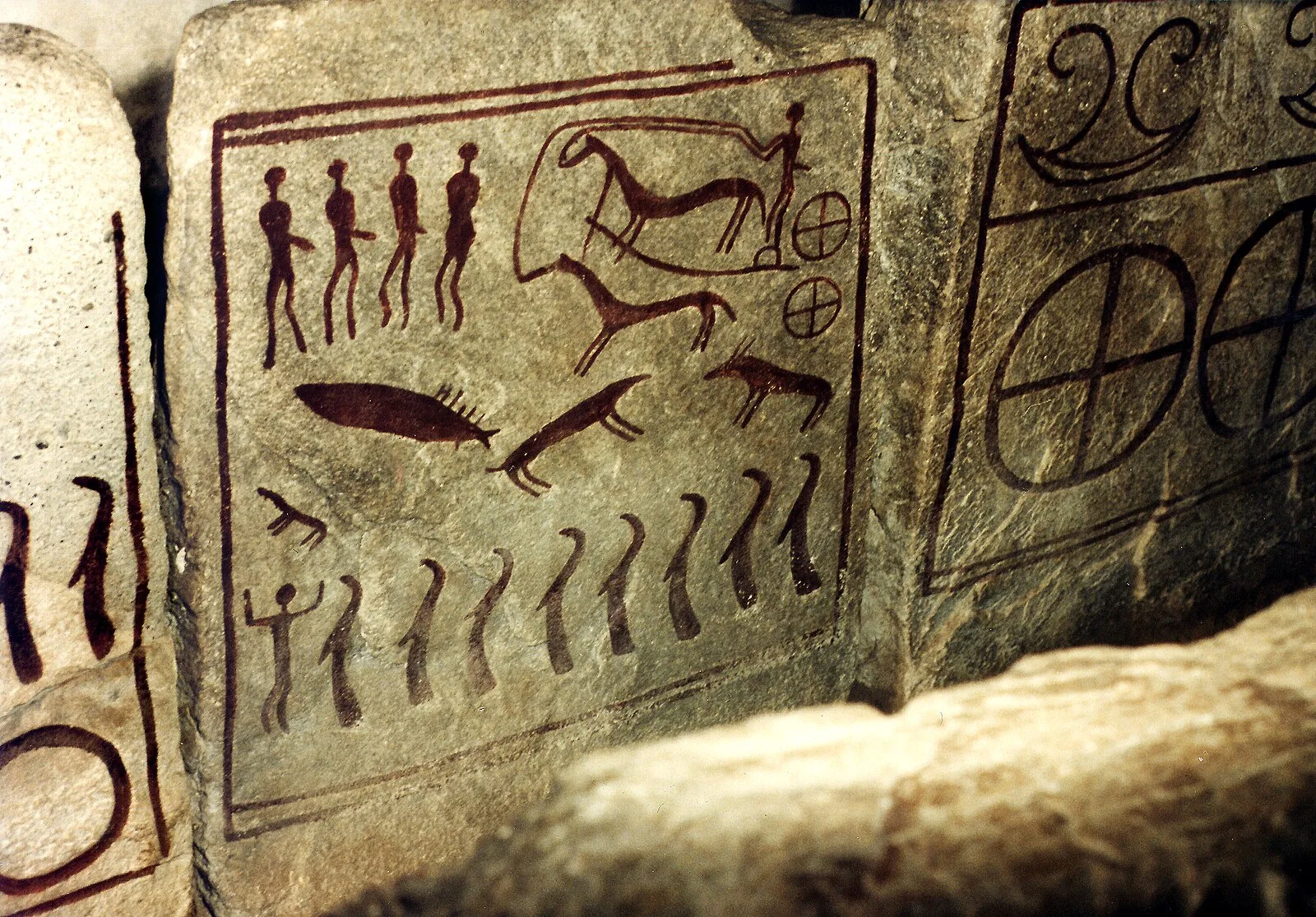
The King's Grave lies near Kivik in southeastern Scania, Sweden [1]. The monument is a cairn, a burial mound constructed largely from stone, and is one of the largest known burial monuments in northern Europe [1]. In its restored form, the circular cairn measures about 75 metres across and 3.5 metres high [1]. Near its centre is a cist, a stone-built burial chamber approximately 4 metres long and 1.5 metres wide [1]. The principal cist is formed from ten upright stone slabs, eight of which are decorated with petroglyphs on the surfaces facing the burial chamber [1]. The carvings depict people, ships, birds, fish, horses, axes, circular symbols and figures playing lurs [1]. Only a small quantity of human remains survived within the principal cist because the monument had been looted before archaeological excavation [1]. Radiocarbon dating showed that the burials took place during at least three separate periods between approximately 1400 and 800 BCE [1].
Text: Wikipedia – 'The King's Grave' (revision of 2026-08-16), CC BY-SA 4.0 · sentences selected and shortened by an AI system · source →The King's Grave
Also known as: Ängakåsen (Koarum), Ängakåsens gravfält, Bredarör, Grab von Kivik, Kivigsgraven, Kivikeko Erregearen hilobia, Kivik-graven, Kivikin kuninkaanhauta, Kivik Kral Mezarı, Kiviksgraven, Kiviksmonumentet, Kiviksröset
| Type | Necropolis/tombs complex |
|---|---|
| Period | 1500 - 500 BC |
| Country | Sweden |
| Coordinates | 55.6834° N, 14.2333° E |