
 Portugal
The Menhir of Meada is believed to be the largest menhir in the Iberian Peninsula that was entirely carved by humans [1]. It is situated 12 km to the north of Castelo de Vide in the Portalegre District of Portugal and is within the protected area of the Serra de São Mamede Natural Park [1]. The monolith, consisting of coarse-grained porphyroid granite, was discovered in a rural area, now used mainly for cork production, in 1965 [1]. Discovered in two pieces, it was restored in the 1990s, when the two parts were joined and the complete stone was replaced in its original location [1]. The menhir's total length is about 7.5 metres, with a maximum diameter of 1.25 metres and a circumference of 3.9 metres at the base [1]. It weighs around 18 tons [1]. Based on radiocarbon dating of coals discovered underneath the base, the menhir is believed to have been raised around 5000 BCE, in the Neo-Chalcolithic period, approximately the same time as the Coureleiros dolmens, or megalithic tombs, that are found in the same district [1].
Text: Wikipedia – 'Menhir of Meada' (revision of 2026-07-18), CC BY-SA 4.0 · sentences selected and shortened by an AI system · source →Menhir of Meada
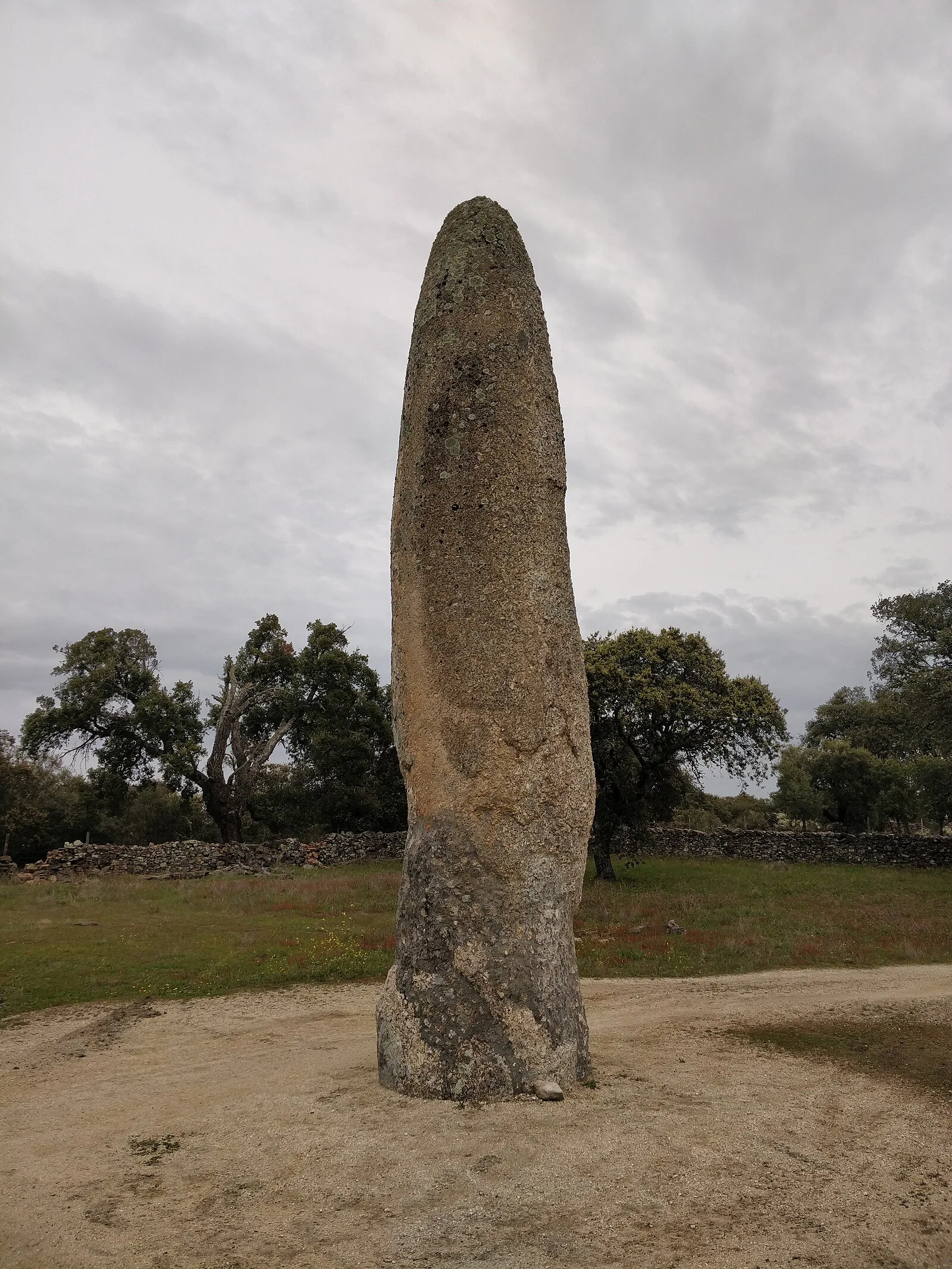
Also known as: Menhir da Meada, Menhir de Meada, Menir da Meada
| Type | Megalithic stones |
|---|---|
| Period | < 4500 BC |
| Country | Portugal |
| Coordinates | 39.4962° N, 7.4457° W |