
 Portugal
The Menhir of Bulhoa (Portuguese: Menir da Bulhoa), also known as the Menhir of Abelhoa, is a granite megalithic standing stone, located near the parish of Monsaraz, in the municipality of the Reguengos de Monsaraz, in the Évora district of the Alentejo region of Portugal [1]. The menhir is thought to date back to between 3500 and 2500 BCE [1]. Overlooked for a long time, it was identified in 1970 [1]. At that time it was lying flat on the ground, with the upper part separated from its base, which had been used in a nearby grape press [1]. It was restored to its original shape soon after discovery, with the fracture remaining very noticeable [1]. The menhir is part of a megalithic nucleus that includes the menhirs of Monte da Ribeira and Outeiro and the Xerez Cromlech [1]. It has a phallic appearance, being about four meters high and one meter in diameter [1]. The stone is decorated with engravings depicting the sun's rays, a staff, and wavy and zigzagging lines [1].
Text: Wikipedia – 'Menhir of Bulhoa' (revision of 2026-07-21), CC BY-SA 4.0 · sentences selected and shortened by an AI system · source →Menhir of Bulhoa
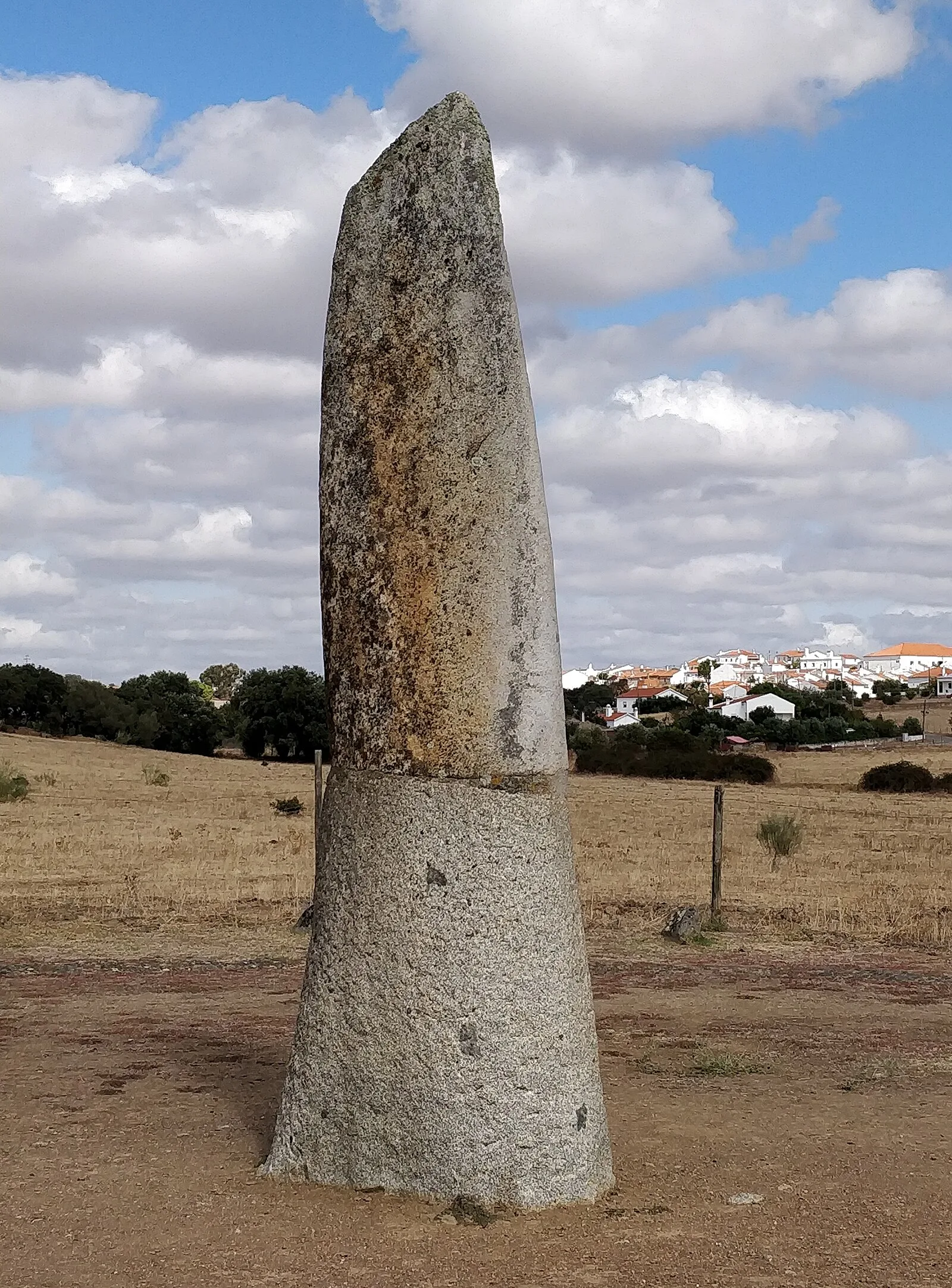
Also known as: Menhir d'Abelhoa, Menhir da Bulhoa, Menhir de Bulhoa, Menir da Abelhoa, Menir da Bulhoa
| Type | Megalithic stones |
|---|---|
| Period | 4500 - 3000 BC |
| Country | Portugal |
| Coordinates | 38.4624° N, 7.3829° W |