
 Portugal
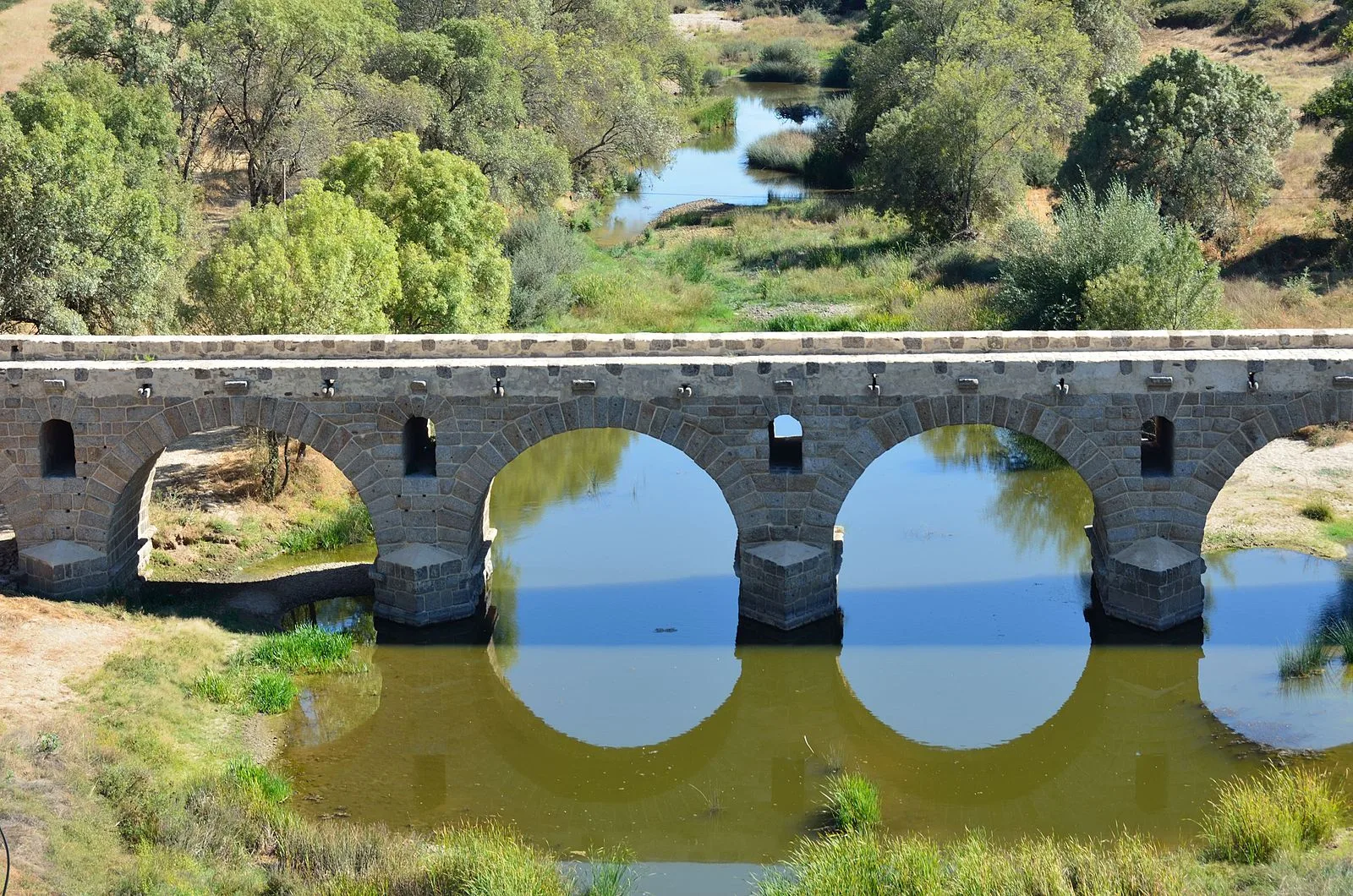
The Roman Bridge of Vila Formosa crosses the Seda stream, close to the village of Seda, in the municipality of Alter do Chão, in the Portalegre District of Portugal [1]. The bridge was part of a Roman road that connected Lisbon to Mérida in Spain [1]. It is approximately 116.50 metres long, 8.40 metres high and 6.70 metres wide [1]. Stone pillars support six 8.95 metre-wide arches, each with 33 voussoirs [1]. The bridge was constructed with portico-shaped eyeholes between the arches to prevent the structure from collapsing during floods, a common practice for Roman bridges [1]. It was decorated with gargoyles [1]. The bridge, which is believed to have been constructed at the end of the 1st century CE, was classified as a National Monument on 16 June 1910 [1].
Text: Wikipedia – 'Roman Bridge of Vila Formosa' (revision of 2025-08-30), CC BY-SA 4.0 · sentences selected and shortened by an AI system · source →Roman Bridge of Vila Formosa
Also known as: Bridge of Vila Formosa, Most Vila Formoza, Pont de Vila Formosa, Ponte da Vila Formosa, Ponte de Vila Formosa, Ponte do Seda, pont romain de Vila Formosa, Puente de Vila Formosa, Vila Formosa Köprüsü
| Type | Gate/archway/bridge |
|---|---|
| Period | 1 - 500 AD |
| Country | Portugal |
| Coordinates | 39.2161° N, 7.7849° W |