
 Peru
PeruThe Sarcophagi of Karajía (Spanish: Sarcófagos de Karajía, or Carajía) are unusually large pre-Inca Chachapoyas culture sarcophagi at the Karajía Archaeological Monumental Zone in the Utcubamba Valley, located 18 km northwest of the city of Chachapoyas, Peru in Trita District, Luya Province [1]. The seven sarcophagi stand up to 2.5 meters tall, constructed of clay, sticks and grasses, with exaggerated jawlines [1]. Their inaccessible location high above a river gorge has preserved them from destruction by looters [1]. However, an earthquake toppled one of the original eight in 1928 [1]. They have been radiocarbon dated to the 15th century, coincident with the Inca conquest of the Chachapoya in the 1470s [1]. The sarcophagi are of a type particular to the Chachapoya called purunmachus [1]. The construction is painted white and overlaid with details of the body and adornment in yellow ochre and two red pigments, such as the feathered tunics and male genitalia visible on the Karajía purunmachus [1].
Text: Wikipedia – 'Sarcophagi of Carajía' (revision of 2026-09-18), CC BY-SA 4.0 · sentences selected and shortened by an AI system · source →Sarcophagi of Carajía
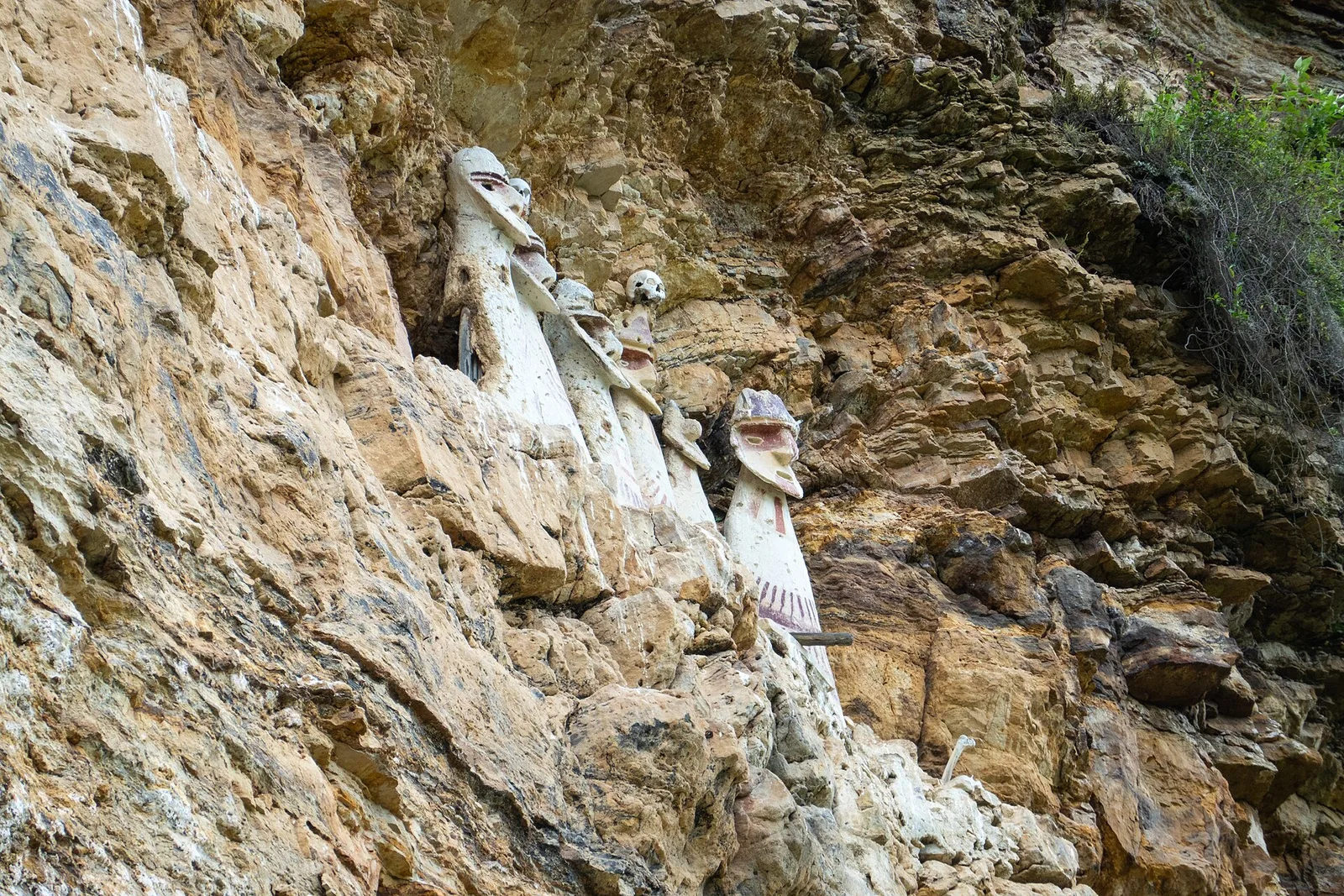
Also known as: Carajia, Karajia, Sarcofagos de Carajía, Sarcofagos de Karajia, sarcophages de Karajia, Sarcophagi of Karajía, sarkofágy Karajía, Zona arqueológica monumental de Karajía, Καραχία, Карахиа, Карахија, კარახია
| Type | Necropolis/tombs complex |
|---|---|
| Period | 1000 - 1500 AD |
| Country | Peru |
| Coordinates | 6.1617° S, 78.0213° W |