
 Peru
PeruThe Huaca Huantinamarca is an archaeological site of the Ichma culture located in San Miguel District, in Lima, Peru [1]. The Huaca Huantinamarca Research, Conservation and Restoration Project identified at least two fundamental phases in its construction [1]. During the first phase, walls of various sizes were built, with predominance of walls 40 and 80 cm thick, using a technique known as formwork [1]. In the second phase, walls with blocks of regular dimensions, a section of which displays a trapezoidal form, which are more structurally stable, were used [1]. Huantinamarca was part of the Maranga complex, and served as the main seat of a community, integrated into the productive and ritual chain linked to the collection, transformation, and consumption of corn chicha used in celebrations and rituals associated with the agricultural calendar [1]. Fragmented ceramic material, vessels and funerary offerings found during excavations are related to the late Ichma period, and some have Chancay and Chimu influence [1].
Text: Wikipedia – 'Huaca Huantinamarca' (revision of 2026-07-21), CC BY-SA 4.0 · sentences selected and shortened by an AI system · source →Huaca Huantinamarca
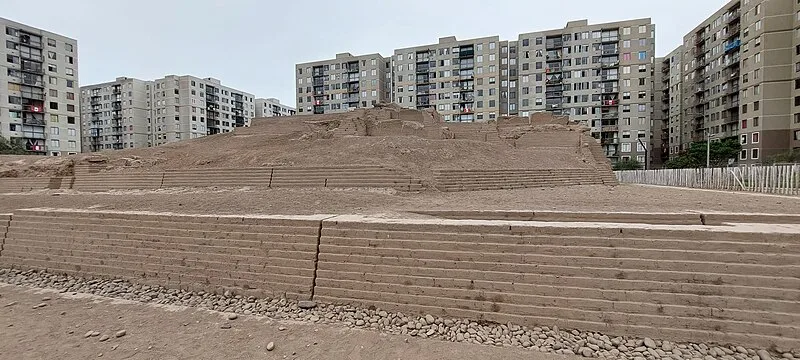
| Type | Pyramid complex |
|---|---|
| Period | 1000 - 1500 AD |
| Country | Peru |
| Coordinates | 12.0831° S, 77.0906° W |