
 Italy
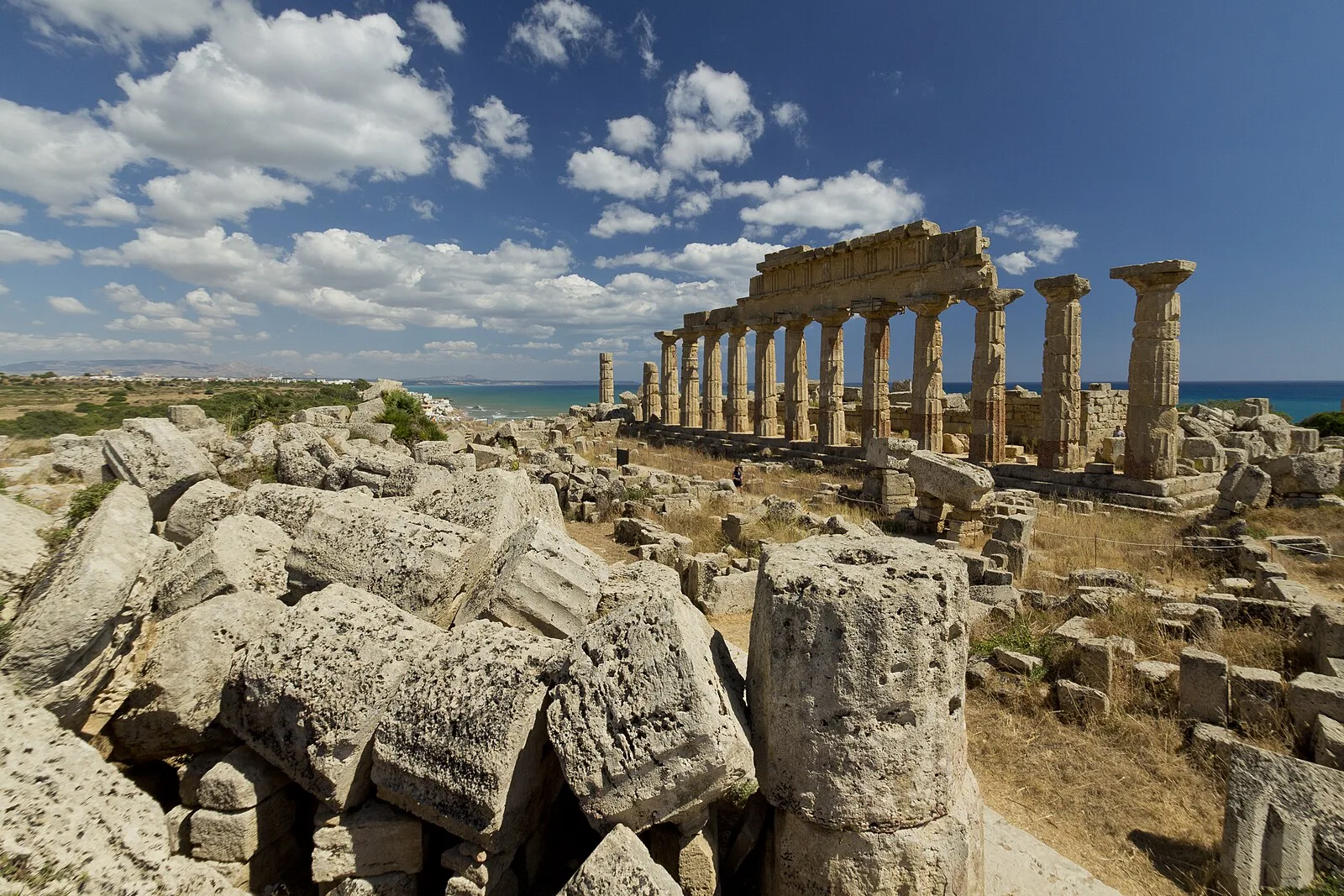
ItalyTemple C at Selinus, is a Greek temple of Magna Graecia in the Doric style [1]. It was one of the most ancient of the temples at Selinus, having probably been built on the acropolis a little after the middle of the sixth century BC, although its dating is controversial [1]. The temple was the object of archaeological research in the nineteenth century and beginning of the twentieth century and later the remains of a long stretch of the northern colonnade received anastylosis in 1929 [1]. Temple C was probably used as an archive (hundreds of seals have been recovered from it) and was dedicated to Apollo, as shown by an inscription, not to Heracles [1]. The building has a peristyle colonnade around the naos, with six columns at the front and seventeen on its long sides, leading to a very elongated floor plan, far from the canonical 1:2 proportion, but paralleled by some other archaic temples [1]. Three metopes survive in full: a frontal view of a quadriga being driven vigorously by Helios, Perseus decapitating Medusa while Athena looks on, Heracles carrying the captured Cercopes on his shoulders [1].
Text: Wikipedia – 'Temple C (Selinus)' (revision of 2026-06-02), CC BY-SA 4.0 · sentences selected and shortened by an AI system · source →Temple C, Selinus
Also known as: C神廟 (塞利努斯), Tempel C in Selinunt, Tempio C, Tempio C di Selinunte, Temple C, Temple C (Selinunt), Temple C (Selinus), Templo C (Selinunte), Templo C (Selinus), Temppeli C (Selinus), Ναός C στον Σελινούντα
| Type | Temple complex |
|---|---|
| Period | 1500 - 500 BC |
| Country | Italy |
| Coordinates | 37.5834° N, 12.8254° E |