
 Italy
ItalyRoca (also known as Rocavecchia or Roca Vecchia) is an archaeological site located on the Adriatic coast of Apulia in Southern Italy, a few kilometres from the modern town of Melendugno and close to the city of Lecce [1]. The site, which has been explored since the end of the 1980s by a team of the University of Salento, has produced some of the best-preserved monumental architecture of the Bronze Age (2nd millennium BC) in Southern Italy, along with the largest set of Mycenaean pottery ever recovered west of mainland Greece [1]. The occupation of the site continued also in the Iron Age and Classical times, when a large natural cavity known as Poesia Cave was used for cult practices involving the writing of thousands of dedications to a local deity in three languages: Greek, Messapic and Latin [1]. Grotta della Poesia is one of the most well known natural rock formations inside the archaeological site [1].
Text: Wikipedia – 'Roca (archaeological site)' (revision of 2026-07-01), CC BY-SA 4.0 · sentences selected and shortened by an AI system · source →Roca Archaeological Site
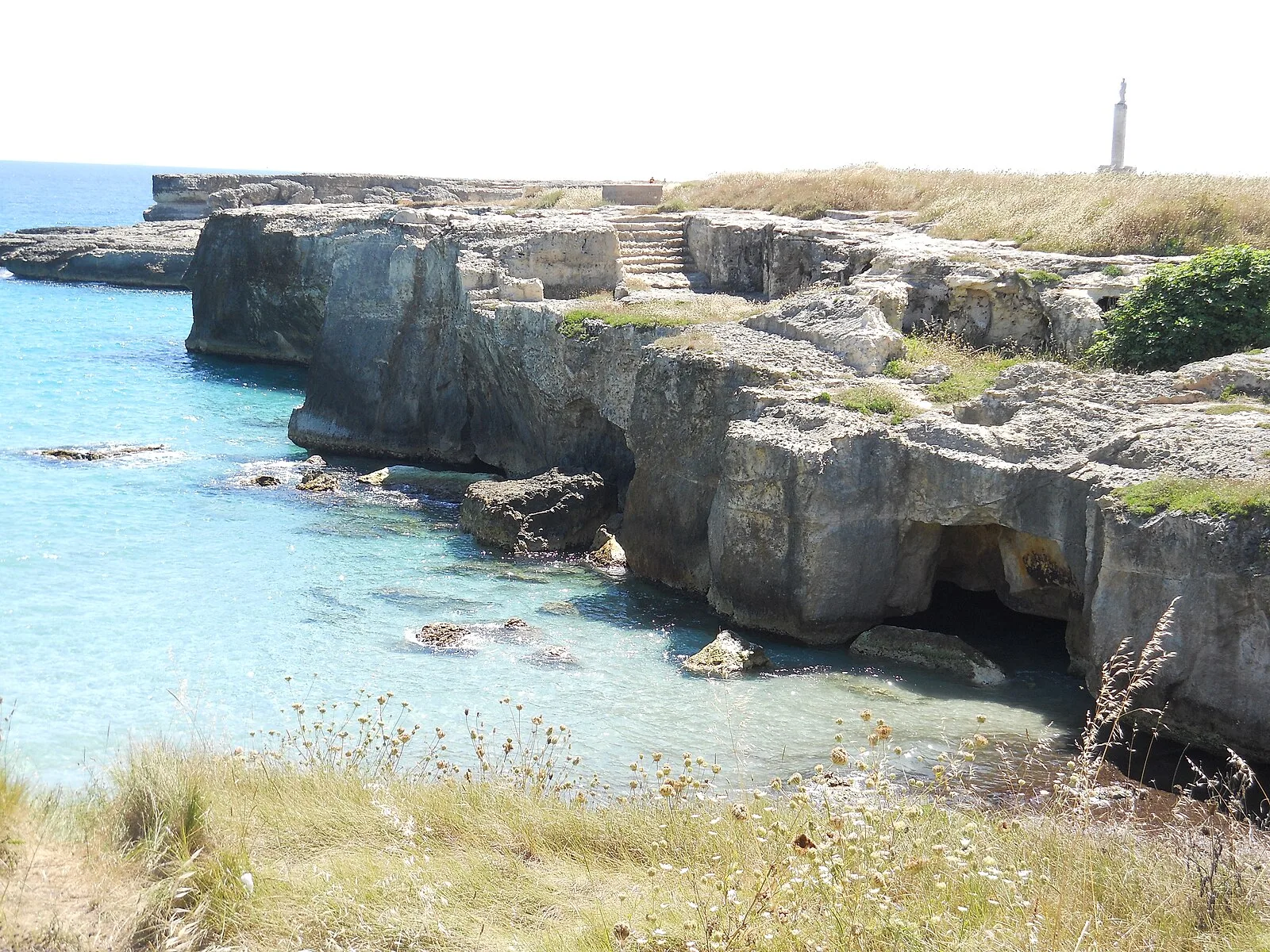
Also known as: Roca (archaeological site), Roca Vecchia, Site archéologique de Roca Vecchia, Роккавекк'я, Рокка-Векк'я, 羅卡 (遺蹟)
| Type | Settlement |
|---|---|
| Period | 3000 - 1500 BC |
| Country | Italy |
| Coordinates | 40.2877° N, 18.4264° E |