
 Israel
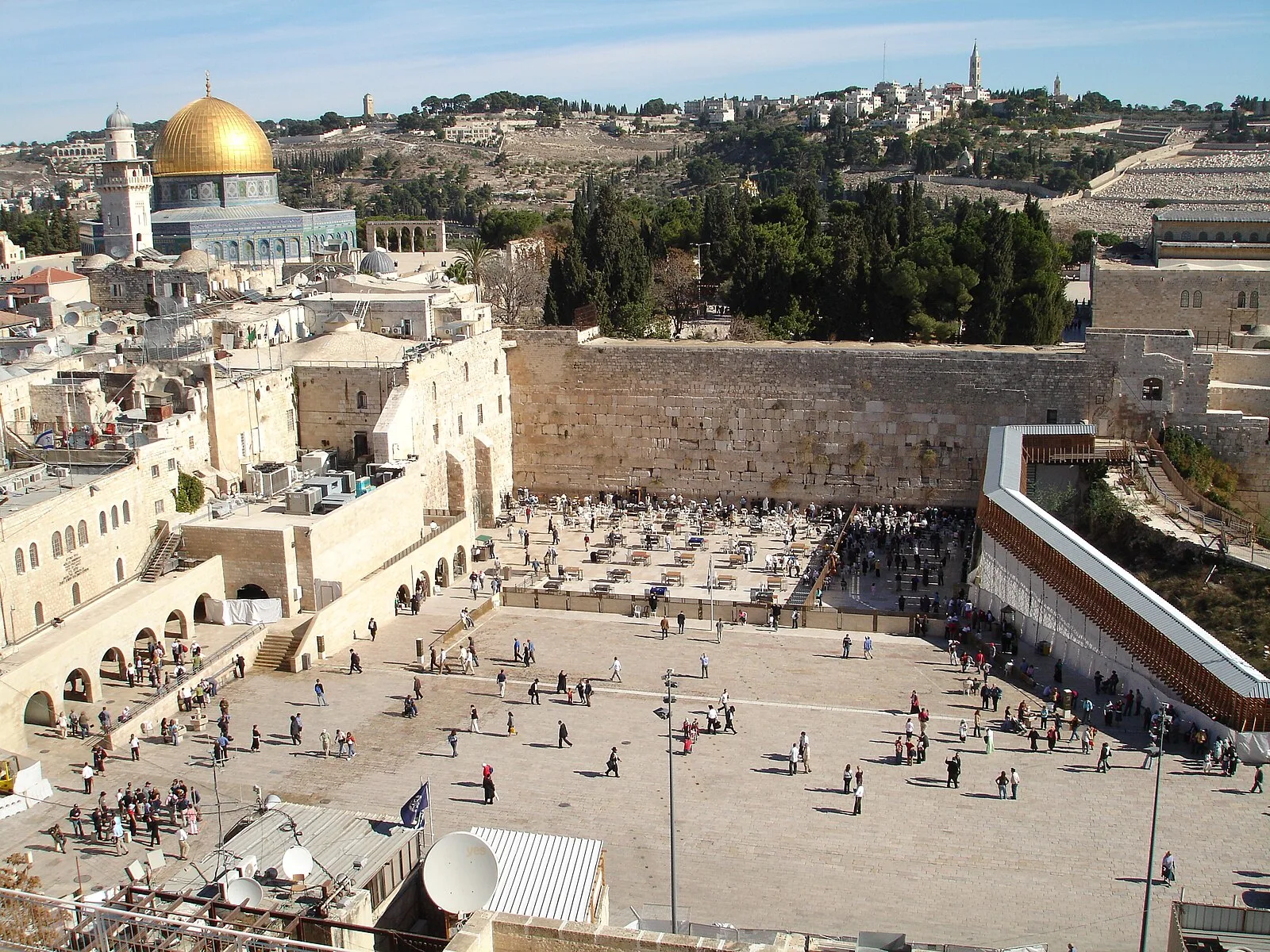
The Western Wall is an ancient retaining wall of the built-up hill known to Jews and Christians as the Temple Mount of Jerusalem [1]. The very large stone blocks of the lower courses are Herodian, the courses of medium-sized stones above them were added during the Umayyad period, while the small stones of the uppermost courses are of more recent date, especially from the Ottoman period [1]. At the Western Wall Plaza, the total height of the Wall from its foundation is estimated at 105 feet (32 m), with the above-ground section standing approximately 62 feet (19 m) high [1]. The Wall consists of 45 stone courses, 28 of them above ground and 17 underground [1]. The first seven above-ground layers are from the Herodian period [1]. This section of wall is built from enormous meleke limestone blocks, possibly quarried at either Zedekiah's Cave situated under the Muslim Quarter of the Old City, or at Ramat Shlomo 4 kilometres northwest of the Old City [1].
Text: Wikipedia – 'Western Wall' (revision of 2026-09-19), CC BY-SA 4.0 · sentences selected and shortened by an AI system · source →Western Wall
Also known as: 통곡의 벽, Ağlama divarı, Ağlama Duvarı, Aieneen Harresia, Al-Buraq Wall, Batı Duvarı, Boalley yn Accan, Bức tường phía Tây, Bức tường Than Khóc, Burāq, Ḥāʼiṭ al-, Buraq Wall, Dêsê Bermayışi
| Type | Megalithic walls |
|---|---|
| Period | 500 BC - 1 AD |
| Country | Israel |
| Coordinates | 31.7769° N, 35.2350° E |